
 English
A warehouse is a factory floor's close cousin — same dust, same constant motion, same people in gloves and safety gear — but the job of the screen is different. In a warehouse, the display is usually showing where things are, what's moving, and what needs attention right now.
Large interactive displays have moved into logistics because they solve a real problem: a warehouse full of people needs one place where everyone can see the same live picture. The paper board and the whiteboard get stale in minutes; the screen updates constantly and everyone sees the same thing.
How warehouses use large interactive displays
In a warehouse or logistics center, a large display usually fills one of a few roles:
Dispatch and tracking boards — live shipment status, dock assignments and driver ETAs displayed where the team can see them.
Inventory dashboards — stock levels, picking queues and order status in real time.
Safety and communication boards — announcements, shift schedules and safety reminders.
Picking and packing support — a touch display lets a worker pull up an order or a bin location without walking back to a terminal.
The common thread is that the display is a shared information surface for a moving, often noisy environment. It has to be readable from a distance and tough enough to be ignored when the floor gets busy.
What the warehouse environment does to a display
A warehouse attacks a display in ways a meeting room never will:
Dust and particulate. Warehouses are dusty, and that dust gets into vents and connectors. A display with poor sealing degrades quickly.
Gloves and touch. Warehouse staff wear gloves. Infrared touch registers a gloved hand the same as a bare one, where capacitive screens struggle — the same reason infrared is standard on factory-floor displays, which we cover in our factory floor guide.
Constant operation. The screen runs through every shift. Power management and component quality decide whether it lasts one year or five.
Vibration and movement. Forklifts, dock doors and moving equipment put vibration through the structure, so the mount and chassis have to be solid.
Why build quality decides how long it lasts
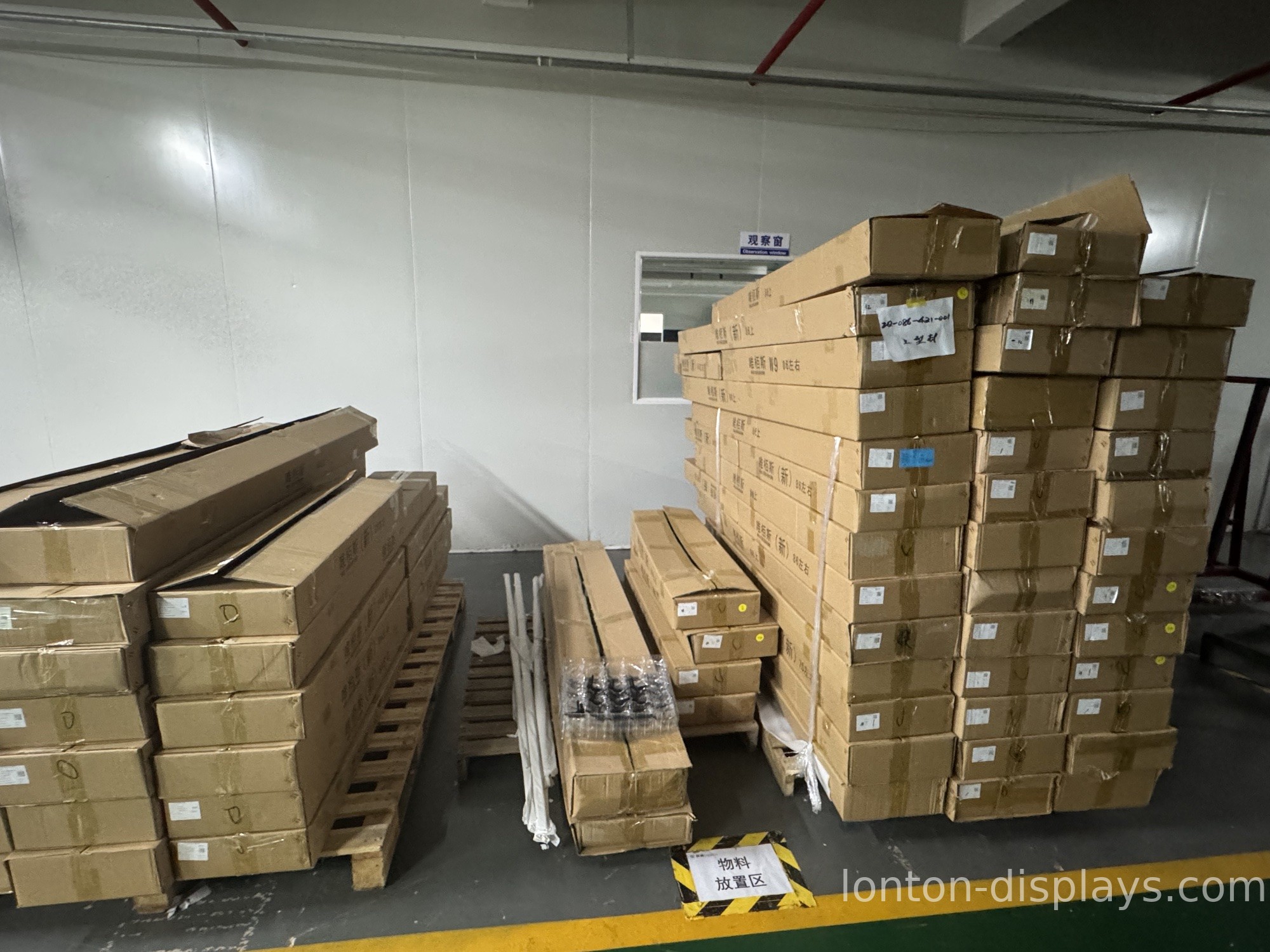
A warehouse display isn't replaced when it gets a bit tired — it gets replaced when it dies, usually at the worst moment. That's why build quality is the deciding factor, and why the manufacturer matters more than the price tag.
A manufacturer that makes its own sheet-metal chassis and mounting brackets can build for vibration and hard use. A manufacturer with its own reliability lab can test the display the way a warehouse will use it — running through shifts, under load, in a dusty room — before it ships. An assembler buying generic parts simply can't make the same promise, and it shows within the first year.
What to look for in a warehouse display
When you're evaluating displays for a warehouse or logistics center, these are the checks that matter:
1. Infrared touch — it works with gloves and handles dust better than capacitive on large screens.
2. Readability at distance — big text and enough brightness for a wide, bright space.
3. Solid mount — ask who makes the bracket and whether it's built for vibration.
4. Continuous operation — confirm the panel is rated to run through full shifts.
5. Reliability testing — a manufacturer with its own lab can show test data, not just claims.
How Lonton fits warehouses and logistics
Lonton has been manufacturing interactive flat panels since 2005, and the logistics use case is close to home — we run our own factory floors with the same live dashboards and displays we sell. That's the same point we make in our factory floor guide: the build quality is in our control because we make the panel, the chassis and the bracket ourselves.
Our panels use 40-point infrared touch that works with gloved hands, run Android 15 built-in, and are tested in our own ORT reliability lab. Because we fabricate our own sheet-metal brackets, the mount holds up to the vibration of a busy floor.
If you're outfitting a warehouse, distribution center or dispatch room, contact us and we'll match the panel to your environment. You can also browse the interactive flat panel range and read our guide to interactive flat panel warranty coverage.
Frequently Asked Questions
Can interactive displays survive a warehouse environment?
Yes, if they're built for it — infrared touch, a solid chassis, sealed against dust and rated for continuous operation. Cheap meeting-room panels won't last.
Do warehouse workers use displays with gloves on?
Yes, and this is where infrared touch matters — it registers a gloved hand the same as a bare one, where capacitive screens struggle.
What do warehouses use large displays for?
Dispatch and tracking boards, inventory dashboards, safety and communication boards, and picking support where a worker pulls up an order without walking back to a terminal.
Why does the manufacturer matter for warehouse displays?
An in-house manufacturer with its own chassis and bracket fabrication and a reliability lab can build and test for hard, continuous use. An assembler cannot guarantee the same durability.
Are warehouse displays the same as factory displays?
They're similar — both need infrared touch, dust resistance and continuous operation. The warehouse display is usually more about tracking and communication, the factory display more about line dashboards and QC.