
 English
A factory floor is the hardest room a display will ever work in. Dust, vibration, temperature swings, forklifts rolling past, and operators who don't have time to be gentle with a touchscreen. The displays that survive there are built differently from the ones that live in a carpeted meeting room.
The interesting part is that the people buying factory-floor displays are usually comparing them to meeting-room panels on price — and that's the wrong comparison. A factory display has a different job, and it needs different hardware to do it.
What interactive displays do on a manufacturing floor
On a factory floor, a large interactive display usually fills one of a handful of roles:
Production dashboards — live output, yield and downtime numbers displayed where the line can see them.
Andon boards — a line goes red when a station has a problem, and everyone can see it.
QC inspection and defect marking — an inspector pulls up a product image and marks defects directly on the panel.
Shift handover — the outgoing shift leaves notes, photos and annotations for the incoming one.
SOP and training display — a station shows the work instruction for the current job.
The common thread is that these displays are tools, not presentation screens. They get touched by people wearing gloves, they run all day, and they have to stay legible under factory lighting.
What factory conditions do to a display
The factory environment attacks a display in a few specific ways, and the spec sheet won't always warn you:
Dust and particulate. Fine dust works its way into vents and connectors. A display with poor sealing starts failing — touch points drift, cooling degrades, and eventually it just stops.
Vibration. Lines vibrate. A panel with a flimsy chassis or cheap mounting can develop loose connections and touch drift within months.
Gloves and touch. Operators wear gloves, which is exactly where infrared touch earns its keep — infrared registers a gloved finger the same as a bare one, where some capacitive screens struggle.
Constant operation. A factory display runs long shifts, every day. Power management, heat dissipation and component quality all matter in a way they don't for a panel used an hour a day.
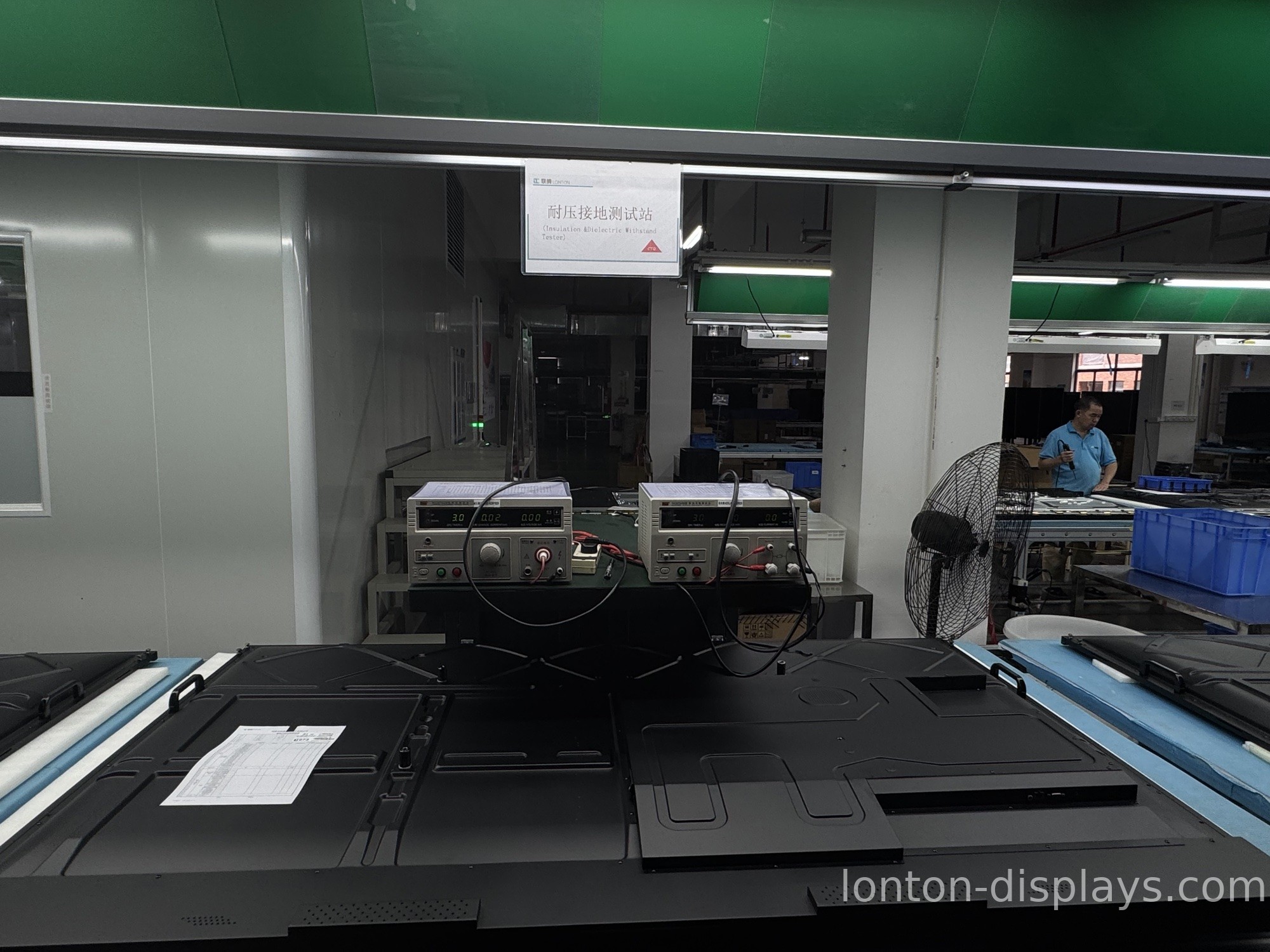
Why the manufacturer is the whole story here
This is the one use case where "who built it" isn't a nice-to-have, it's the deciding factor. A factory-floor display has to be assembled, sealed and tested by people who understand industrial conditions.
That's where an in-house manufacturer separates from a trading company. A factory that makes its own sheet-metal back panels and brackets can build a chassis that holds up to vibration. A factory with its own reliability lab can test a display the way a real line will use it — powered on for days, under load, with temperature cycling — before it ships. An assembler buying generic parts and screwing them together simply can't guarantee the same thing.
We make this point in more depth in our guide to how to vet an interactive flat panel factory.
What to look for in a factory-floor display
When you're evaluating displays for the floor, these are the checks that matter:
1. Infrared touch — it works with gloves and is more forgiving of dust than capacitive on large screens.
2. Build and chassis — ask who makes the metal enclosure and whether it's rated for industrial use.
3. Reliability testing — a manufacturer with its own reliability lab can show you test data, not just claims.
4. Brightness — factory lighting is bright; make sure the panel is legible under it.
5. Duty cycle — confirm the panel is rated to run all day, not intermittently.
How Lonton builds for the factory floor
Lonton has been manufacturing displays since 2005, and the factory floor is a use case we take personally — because we run one. Our own production uses the same kinds of displays we sell: 15 production lines, live dashboards, and QC stations where defects are marked on-screen.
That's why the build quality is in our control rather than someone else's. We make our own sheet-metal back panels and mounting brackets in our own fabrication shop, run our own LCD module workshop, and maintain an ORT reliability lab where panels are tested under load before shipping. The touch is 40-point infrared, which works with gloved hands, and the panels run Android 15 built-in with anti-glare tempered glass that stays legible under bright lighting.
If you're spec'ing displays for a production line, QC station or shift handover, contact us and we'll match the panel to your environment. You can also browse the interactive flat panel range and read our guide to interactive flat panel warranty coverage.
Frequently Asked Questions
Can interactive displays survive a factory environment?
Yes, if they're built for it — infrared touch, a solid chassis, sealed against dust and rated for continuous operation. Cheap meeting-room panels won't last.
Do factory operators use touch with gloves on?
Yes, and this is where infrared touch matters — it registers a gloved finger the same as a bare one, where some capacitive screens struggle.
What is an andon board?
A production display that shows line status in real time and turns red when a station has a problem, so the whole floor can see it at a glance.
Why does the manufacturer matter for factory displays?
An in-house manufacturer with its own sheet-metal fabrication and reliability lab can build and test for industrial conditions. An assembler using generic parts cannot guarantee the same durability.
Can I mark defects on the display during QC inspection?
Yes — an inspector can pull up a product image and mark defects directly on the panel, which is faster than paper records and keeps the record digital.