
 English
A hospital isn't like a school, and a board bought for a training room has to work under conditions a classroom panel never faces. The screen sits in a simulation lab next to patient manikins, in a surgical teaching suite, or in a lecture theatre where residents are scrubbing in on procedures. It gets used hard, it has to show anatomy and imaging with no room for error, and it can't go down in the middle of a demonstration.
That's why medical training is one of the few places where the cheap panel is never the right answer. The requirements are specific, and they don't show up on a standard spec sheet.
How interactive flat panels are actually used in medical training
The use cases break down into a few distinct jobs:
Surgical demonstration — a procedure is streamed or shown on a large panel so a roomful of trainees can follow every step.
Anatomy and imaging review — CT, MRI and X-ray images are pulled up and annotated during a teaching session.
Clinical simulation — the panel drives or displays a simulation scenario, often next to a patient manikin.
Grand rounds and lectures — the panel replaces the projector for case presentations and department meetings.
Each of these puts a different demand on the hardware, which is why the "one panel for everything" pitch is usually wrong for a hospital.
The specs that matter more in a medical setting
A few specifications matter in medicine that would be minor elsewhere:
Image accuracy. When a panel is showing a scan, the grayscale has to be honest. A cheap panel with oversaturated color and blown-out highlights can make a subtle lesion hard to see. You're not buying a diagnostic monitor — that's a separate, certified device — but the training panel still needs to be color-stable and sharp enough that the image on screen matches what's on the workstation.
Hygiene and cleanability. Medical rooms get wiped down constantly, and the panel surface has to survive disinfectant without clouding or degrading. Anti-glare tempered glass that can be cleaned with standard medical wipes is the practical requirement, and it's worth asking the vendor directly.
Reliability. A panel that fails mid-demonstration isn't just an inconvenience, it's a liability. This is where build quality — and the manufacturer behind it — starts to matter more than the price.
Why the manufacturer matters more than the spec sheet
Here's the part most buyers skip: two panels can list identical specs and behave completely differently over three years of hard use. The difference is the factory behind them.
A manufacturer that makes its own LCD modules, its own sheet-metal brackets and back panels, and runs its own reliability lab can control quality in a way a trading company assembling from whatever's cheapest cannot. That matters in a hospital, where the panel has to keep working through years of daily demonstrations, constant cleaning and the occasional accidental knock. Ask who actually makes the panel, not just who sells it.
What to check before you buy
When you're shortlisting for a medical training room, add these to the evaluation:
1. Can the surface be disinfected? Ask for the cleaning guidance in writing.
2. How accurate is the image? Test with real scans, not marketing photos.
3. Who manufactures it? A factory with its own LCD module line and reliability lab is a different proposition from an assembler.
4. What's the touch responsiveness? Demonstrations are fast; a laggy board breaks the flow of a surgical walkthrough.
5. Is there on-site support? For a hospital, response time matters more than for a school.
How Lonton fits medical training
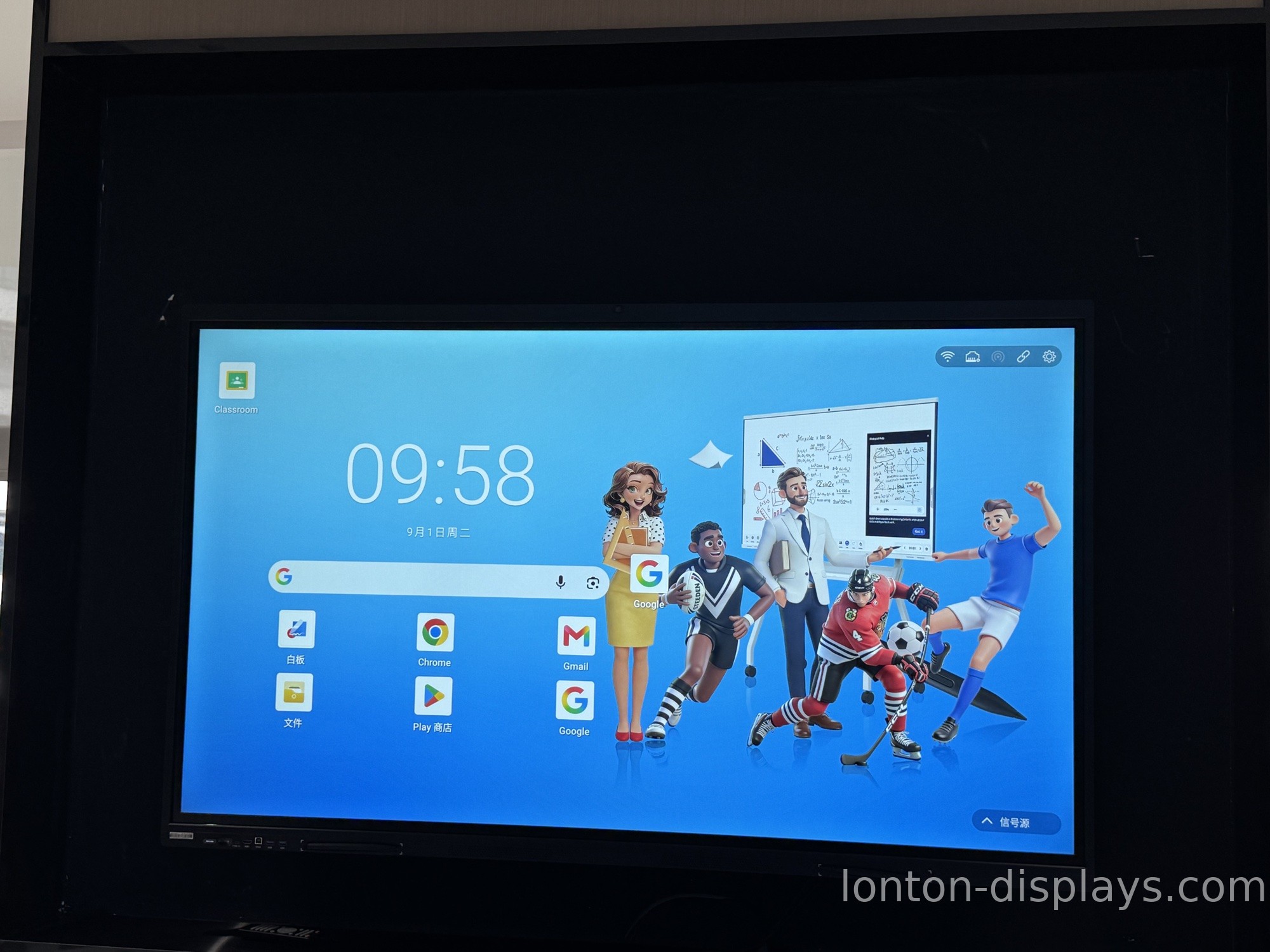
Lonton has been manufacturing interactive flat panels since 2005, and the build quality that matters in a hospital is exactly what we control in-house. We run our own LCD module workshop and our own sheet-metal fabrication — the back panels and mounting brackets are made in our own factory, not bought in — and we maintain an ORT reliability lab where panels are stress-tested before they ship.
Our panels use 40-point infrared touch with under 10 ms response time and ±1 mm accuracy, run Android 15 built-in, and carry ISO 9001/14001/45001 plus CE, FCC and RoHS. The tempered glass is anti-glare and scratch-resistant, built to survive the daily wipe-downs a clinical environment demands.
If you're outfitting a simulation lab, surgical teaching suite or grand-rounds theatre, contact us and we'll walk you through the right panel for each room. You can also browse the interactive flat panel range and read our guide to what certifications an interactive flat panel should have.
Frequently Asked Questions
Are interactive flat panels used in medical training?
Yes — for surgical demonstration, anatomy and imaging review, clinical simulation and grand rounds. The panel replaces the projector and adds annotation and collaboration.
Can you show X-rays and scans on an interactive flat panel?
Yes, for teaching. A training panel should be color-stable and sharp so images read correctly, but it is not a certified diagnostic monitor — that's a separate device.
Can interactive flat panels be disinfected?
A panel with anti-glare tempered glass can be wiped down with standard medical disinfectant. Ask the vendor for written cleaning guidance before you buy.
What should a hospital check before buying a training panel?
Surface cleanability, image accuracy, who manufactures it, touch responsiveness and on-site support. Reliability matters more than price in a clinical setting.
Who makes Lonton panels?
Lonton manufactures them in-house — we run our own LCD module workshop, sheet-metal fabrication and an ORT reliability lab, rather than assembling from outsourced parts.