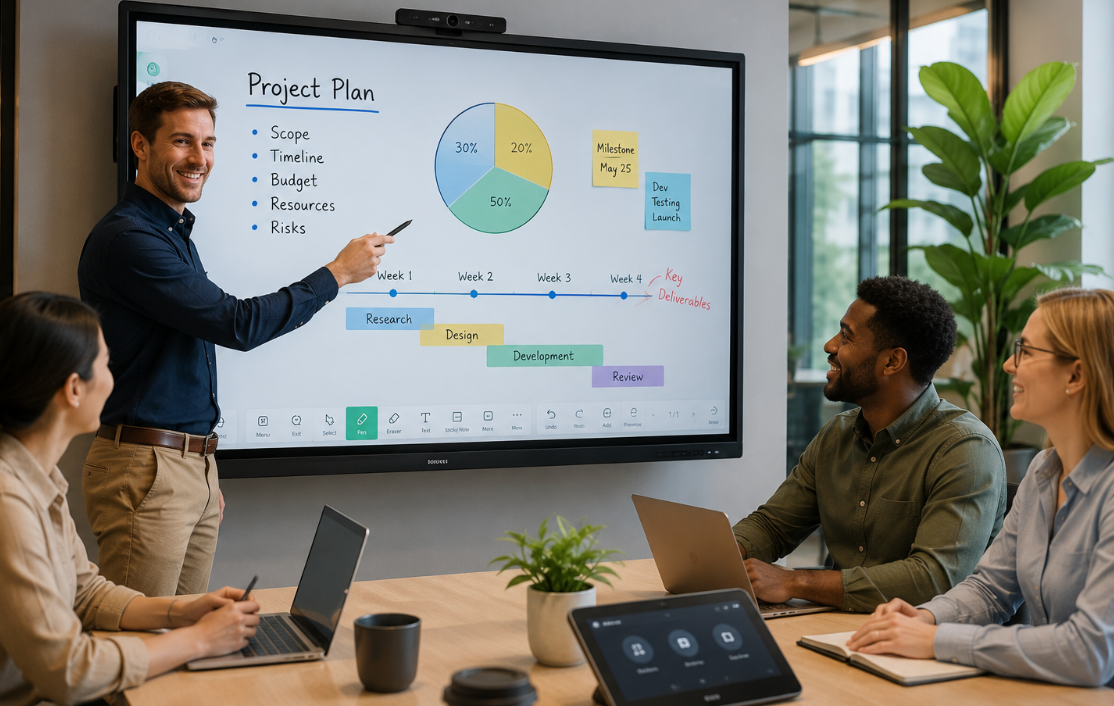
 English
Wall Mounted vs Mobile Stand Smart Board: Which Setup Wins (2026)
The panel arrives. The crate is open. And someone asks the question that should have been answered three weeks ago: does this go on the wall or on a cart. The decision shapes how the room works every day, and it is not just about whether the wall can hold the weight.
Wall Mounted: Clean, Permanent, Professional
A wall-mounted interactive flat panel looks like it belongs. The display sits flush against the wall with cables hidden behind it or run through the wall, and the result is a clean conference room that does not announce its technology. There are no trip hazards, no cart to wheel around, and no floor space consumed beyond the wall footprint.
The trade-offs are real, though. Once the panel is on the wall, it stays there. If your organization rearranges meeting rooms, switches the orientation of the room, or moves offices, the panel needs to be unmounted, the wall needs patching, and the process repeats at the new location. A wall mount also requires a sturdy wall — drywall with studs at minimum, or concrete with proper anchors — and if the ideal mounting position does not align with stud spacing, the installation gets more complicated and more expensive.
Cable management matters more with a wall mount because the cables are permanently routed. An HDMI cable that is too short after the final positioning, or a power outlet that sits two inches out of reach, turns a one-hour installation into an electrician visit. Plan the cable paths before the mount goes up, and budget for a recessed outlet behind the panel if the room does not already have one.

Mobile Stand: Flexible, Movable, Visible
A mobile stand puts the interactive flat panel where you need it today and somewhere else tomorrow. Training rooms that serve different group sizes, multi-purpose spaces that host meetings in the morning and workshops in the afternoon, and organizations that lease their office space and expect to move within a few years all benefit from the flexibility of a cart.
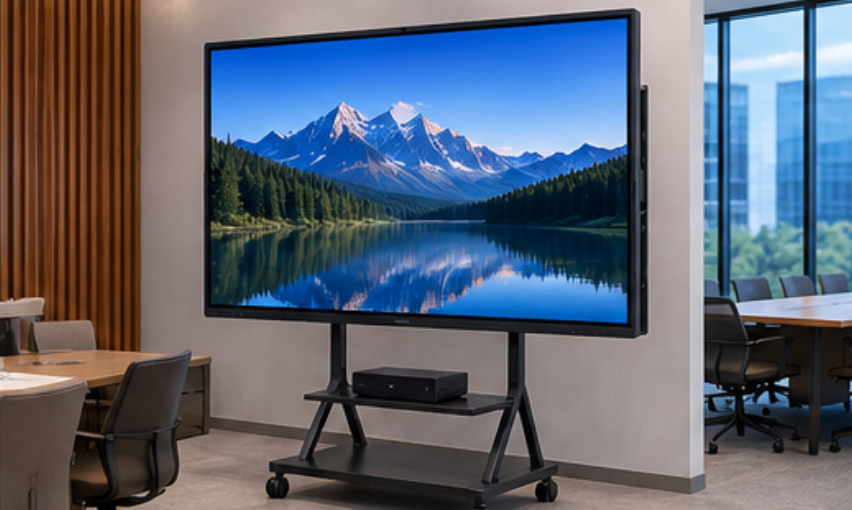
The stand itself is a steel frame with locking casters, typically supporting panels up to 98 inches. Quality stands include internal cable routing through the frame so the power and network cables are not dangling off the back, and some higher-end models offer motorized height adjustment — useful in education settings where the panel needs to drop to a lower height for younger students or wheelchair access.
The downsides are floor space and stability. A mobile stand pushes the panel roughly two feet out from the nearest wall, which matters in smaller rooms. The wheels need to be locked every time the panel is positioned, or a bump sends 150 pounds of touchscreen rolling. And because the cables run along or inside the stand rather than through the wall, they are more visible and more exposed to foot traffic, though cable management sleeves help.
How to Decide
Start with the room, not the preference. If the meeting room has a fixed layout and the panel will always face the same direction, wall mount. The installation is a one-time cost, the room stays clean, and the panel becomes part of the architecture rather than a piece of furniture that needs to be positioned before every meeting.
If the room serves multiple purposes or the organization is likely to reconfigure spaces, go with a mobile stand. The upfront cost of a good stand — roughly $300 to $600 for a motorized model rated for larger panels — is modest compared to the cost of unmounting and reinstalling a wall-mounted panel during an office move.
Some organizations land on a hybrid approach: wall mount in dedicated conference rooms and mobile stands in training rooms and huddle spaces. The wall mounted vs mobile stand smart board question does not need a single answer across the whole building. It needs the right answer per room.
For buyers working with LonTon interactive flat panels, both mounting options are supported. The panels ship with standard VESA mounting patterns that work with most wall mounts and mobile stands on the market, and the weight and dimensions are available before purchase so installers can verify wall suitability and stand compatibility before the panel arrives.
As a professional manufacturer, LonTon helps buyers plan the full room setup before the order ships — mounting type, cable routing, and accessory configuration — so the panel arrives ready for what your rooms actually need. The wall mounted vs mobile stand smart board choice is one of those decisions that costs nothing to get right before the crate arrives, and plenty to fix afterward.