
 English
Types of Interactive Whiteboards: A Simple Guide (2026)
Walk into a showroom or scroll through a distributor catalog, and the options look like a wall of identical glass rectangles. But the types of interactive whiteboards on the market differ in touch technology, portability, and operating system — and each type suits a different room.
By Touch Technology
Infrared touch panels use a frame of IR LEDs and sensors around the bezel that detects when a finger or stylus breaks the light beam. This is the most common technology in meeting room panels because it supports multiple simultaneous touch points and works with any object — finger, stylus, or even a gloved hand. It is also cost-effective to manufacture at larger sizes, which is why most 75-inch and 86-inch panels use infrared.
Capacitive touch panels use the same principle as a smartphone screen — a conductive grid senses the electrical charge of a fingertip. The experience is smoother and more responsive than infrared, with no bezel frame around the edges, giving the panel a cleaner look. Capacitive panels work only with conductive touch — a finger or a special capacitive stylus — and are more common in premium models and smaller sizes where the manufacturing cost difference is narrower.
Both technologies have their place, and many manufacturers offer both. LonTon produces both infrared and capacitive interactive flat panels, letting buyers choose based on their room environment and budget rather than being locked into one technology.

By Installation Type
Fixed wall-mounted panels are the standard for dedicated meeting rooms and classrooms. They mount to the wall with a VESA bracket, cables route through or behind the wall, and the panel stays in place for years. This is the setup for rooms with a defined front-of-room orientation.
Portable panels on mobile stands serve multi-purpose spaces. The stand is a steel cart with locking casters, and the panel can be wheeled between rooms or pushed against a wall when not in use. Training centers, flexible office layouts, and schools that share equipment across classrooms are the main users of portable IFPs.
By Operating System
Most modern interactive whiteboards run Android as their native OS, giving access to the Google Play Store for app installation. Some models also include an OPS slot for a Windows module, which turns the panel into a full Windows PC — useful for organizations that rely on desktop Office, legacy software, or Windows-based video conferencing platforms. Panels without an OPS slot are Android-only, which covers most meeting room needs but limits desktop software compatibility.
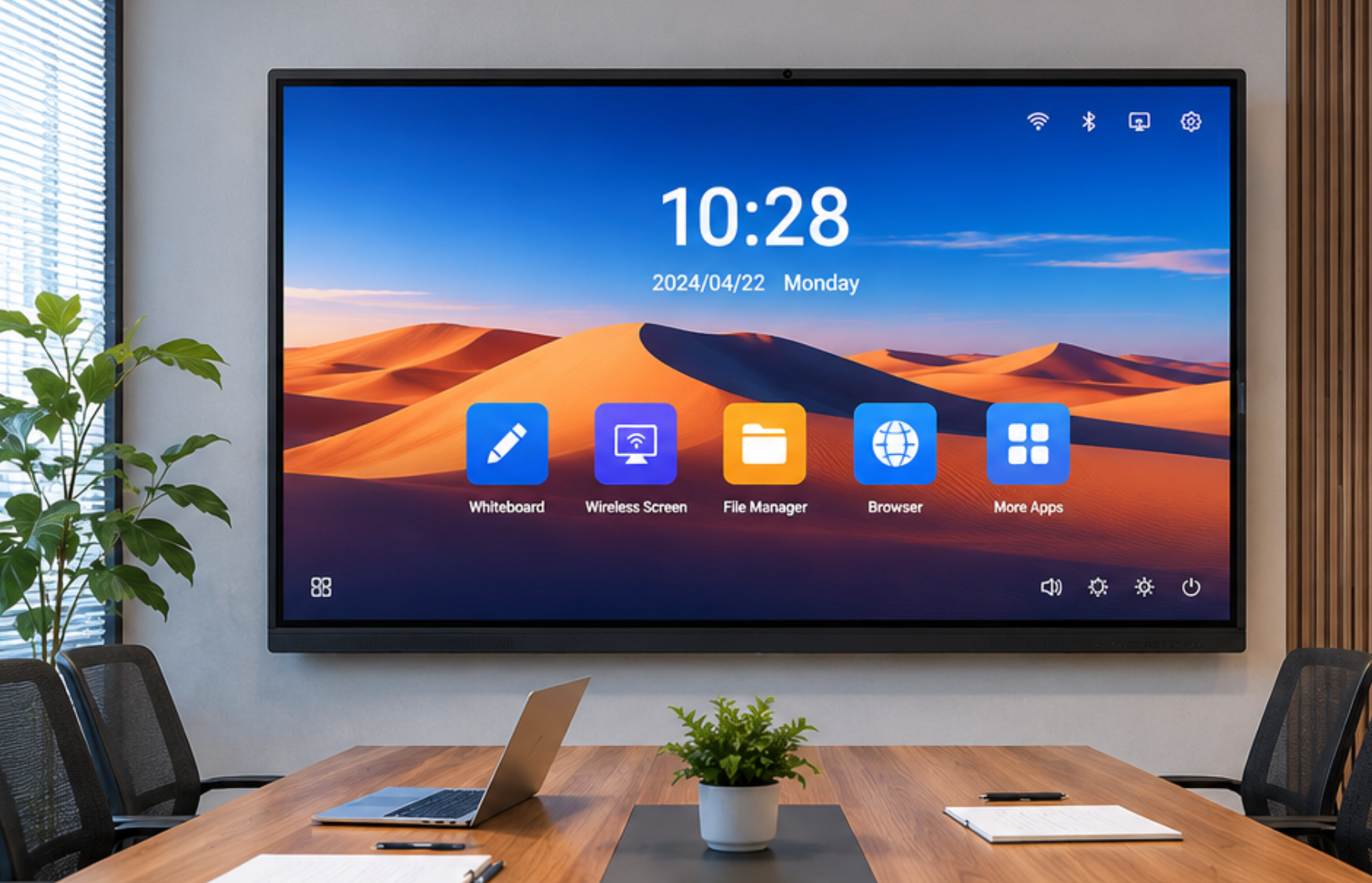
The types of interactive whiteboards come down to how you answer three questions: infrared or capacitive, wall or cart, Android-only or Android plus Windows. As a professional manufacturer, LonTon offers configurable options across all three dimensions so the panel matches the room rather than the other way around. Understanding the types of interactive whiteboards available means you walk into the buying process knowing what to ask for.