
 English
Smart Board Specs for Government: What to Look For (2026)
If you are evaluating smart board specs government use, you already know this is not the same as buying for a corporate office. Government procurement has its own rulebook — security requirements, accessibility standards, vendor approval processes, and funding cycles that do not move at the speed of a startup's purchasing department.
Most guides for interactive flat panels assume a business buyer. Here is what matters when the buyer is a government agency.
Security Is Not Optional
In a corporate meeting room, the biggest data concern is usually "did someone leave the quarterly numbers on the screen after the meeting ended." In a government setting, the stakes are higher. Classified discussions. Sensitive policy documents. Personally identifiable information about citizens.
The display itself needs to fit into your existing security architecture. Does the operating system support network-level authentication — meaning the board only connects after verifying its identity on the network? Can IT remotely wipe the device if it is stolen or compromised? Does the board's firmware update through a secure, verified channel, or does it auto-update from the open internet?
Some interactive flat panels run on consumer operating systems that phone home to the manufacturer's servers for updates, analytics, and telemetry. In a government environment, that is a non-starter. Look for a panel that can operate fully offline or on an air-gapped network. Ask the supplier whether the board can be locked down — USB ports disabled, app installation restricted to an approved whitelist, network access limited to specific internal addresses.
If your agency requires specific encryption standards — for data at rest on the device, for data in transit during wireless screen sharing — put those requirements in the RFP. Not every manufacturer can meet them.

Accessibility and Section 508 Compliance
Government agencies in the United States must comply with Section 508 of the Rehabilitation Act, which requires information technology to be accessible to people with disabilities. Similar laws exist in the European Union, Canada, Australia, and other jurisdictions.
For an interactive flat panel, accessibility means more than a large screen. Can a user who is blind or has low vision navigate the interface with a screen reader? Does the whiteboarding software support keyboard-only operation — no touch required — for users with motor impairments? Is the display mount adjustable so a wheelchair user can reach the interactive surface?
If the board includes audio features — speakers, microphones, video conferencing — are those compatible with hearing assistive technologies? Can captions be displayed and positioned during video calls?
Ask the manufacturer for their Voluntary Product Accessibility Template (VPAT) or equivalent accessibility conformance report. A supplier who cannot produce one has either not done the work or does not know what Section 508 means. Either way, that is a problem for a government procurement.
The Procurement Reality
Government buyers do not swipe a credit card and order three panels online. You have an RFP process, approved vendor lists, budget approvals that might span fiscal years, and documentation requirements that corporate buyers never see.
This changes what you need from a supplier. Can the manufacturer provide a detailed bill of materials and spec sheet suitable for inclusion in an RFP response? Do they have experience working with government procurement timelines — meaning they understand that a quote might need to be valid for ninety days, not seven? LonTon provides detailed technical documentation suitable for government RFPs — bills of materials, compliance reports, and spec sheets that procurement teams can drop directly into their evaluation packages.
Ask about past government contracts. A manufacturer who has supplied panels to a city council chamber, a federal training facility, or a state emergency operations center has been through the process before. They understand that delivery schedules sometimes get delayed by funding releases. They understand that installation might need to happen over a weekend or after hours with security clearance requirements. If a supplier cannot point to specific government projects they have completed, ask how they plan to handle these logistics. The answer will tell you whether they are ready for this kind of engagement.
Warranty and support also look different. A government agency cannot ship a broken panel back and wait three weeks for a replacement. Ask about on-site service, advance replacement, and whether the supplier has service partners in your region or state. These terms are negotiable for government contracts — but only if you ask before signing.
Where the Panels Actually Go
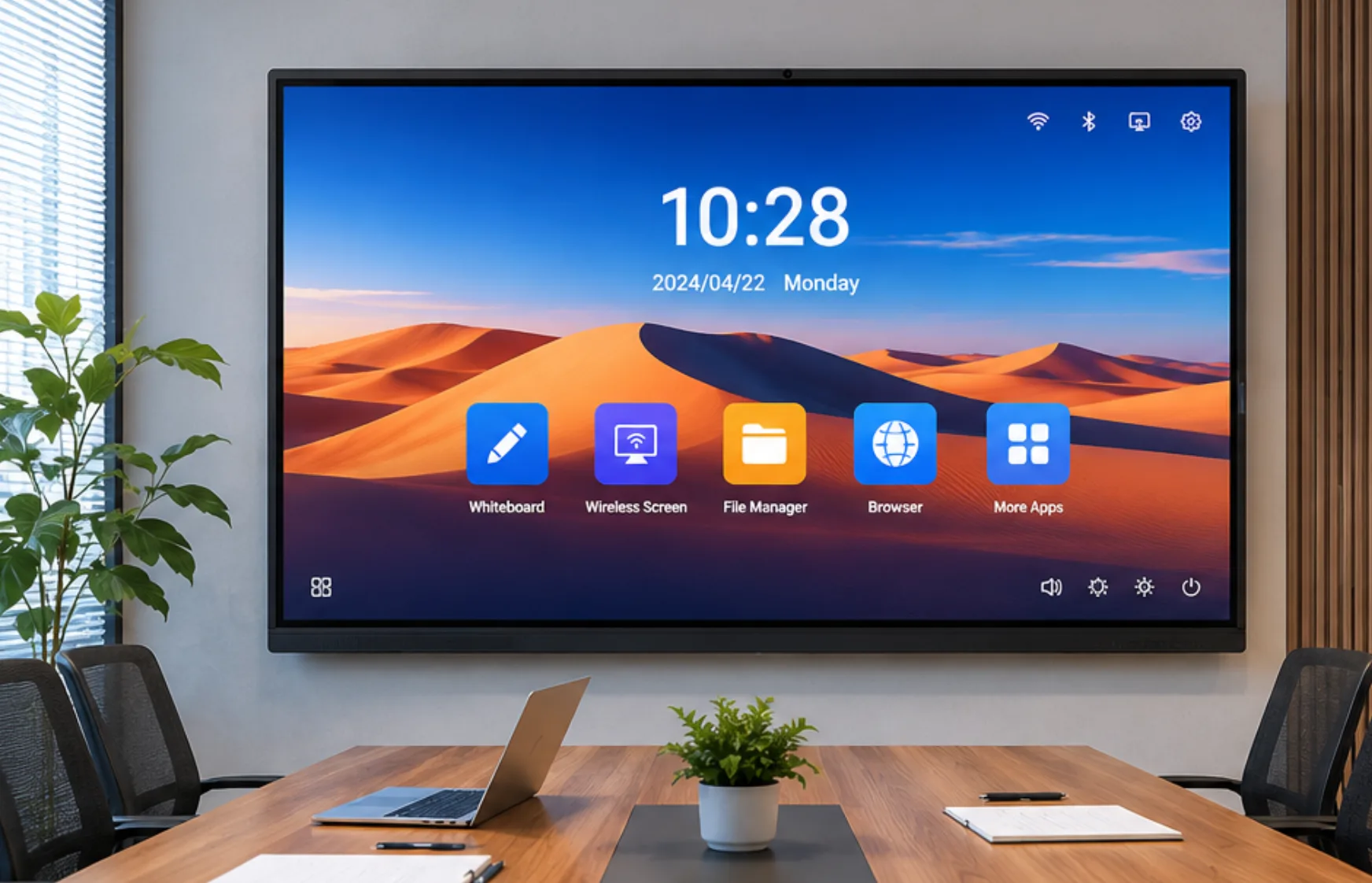
Smart board specs government use vary dramatically by room type, even within the same building.
A city council chamber or a legislative hearing room needs a large display — 86 inches or larger — visible from every seat in a room that might hold fifty or more people. Audio reinforcement and broadcast-quality video output for public access television or live streaming add another layer of complexity. The panel is not just a meeting tool. It is part of the public record.
An emergency operations center or a situation room runs twenty-four hours a day during a crisis. The panels need to handle continuous use without overheating or degrading. Redundancy matters — if one display fails during an active emergency, there needs to be a backup. Multiple panels displaying different data feeds — weather maps, resource tracking, communication logs — need to be managed from a central control point.
A training facility or a staff development room has more standard needs — a 65-inch or 75-inch panel, reliable wireless sharing, a camera for remote instructors. The priority here is durability and ease of use across different trainers and different sessions throughout the day.
An executive briefing room for agency leadership needs to look professional and work flawlessly. No visible cables. No calibration delays. No "can everyone hear me?" The technology needs to disappear so the conversation can happen.
Government procurement rewards clarity. The more specific you can be about your security requirements, your accessibility obligations, your room types, and your procurement constraints, the easier it is to filter out suppliers who are not ready for this kind of engagement.
If your agency is evaluating smart board specs government use and you want to talk through the details, click the button at the bottom right of this page. LonTon has been manufacturing interactive flat panels since 2005. Tell us about your requirements, your timeline, and your procurement constraints. We will help you figure out what fits.