
 English
Smart Board vs LED Video Wall: Which for Your Conference Room (2026)
A smart board vs LED video wall decision usually starts with a simple question: how big does the screen need to be. But the real answer depends on what the room is used for, not just its dimensions. These two technologies solve different problems, and picking the wrong one means either overspending on capability you will never use or buying something that falls short the day a client walks in.
What Each Technology Does Well
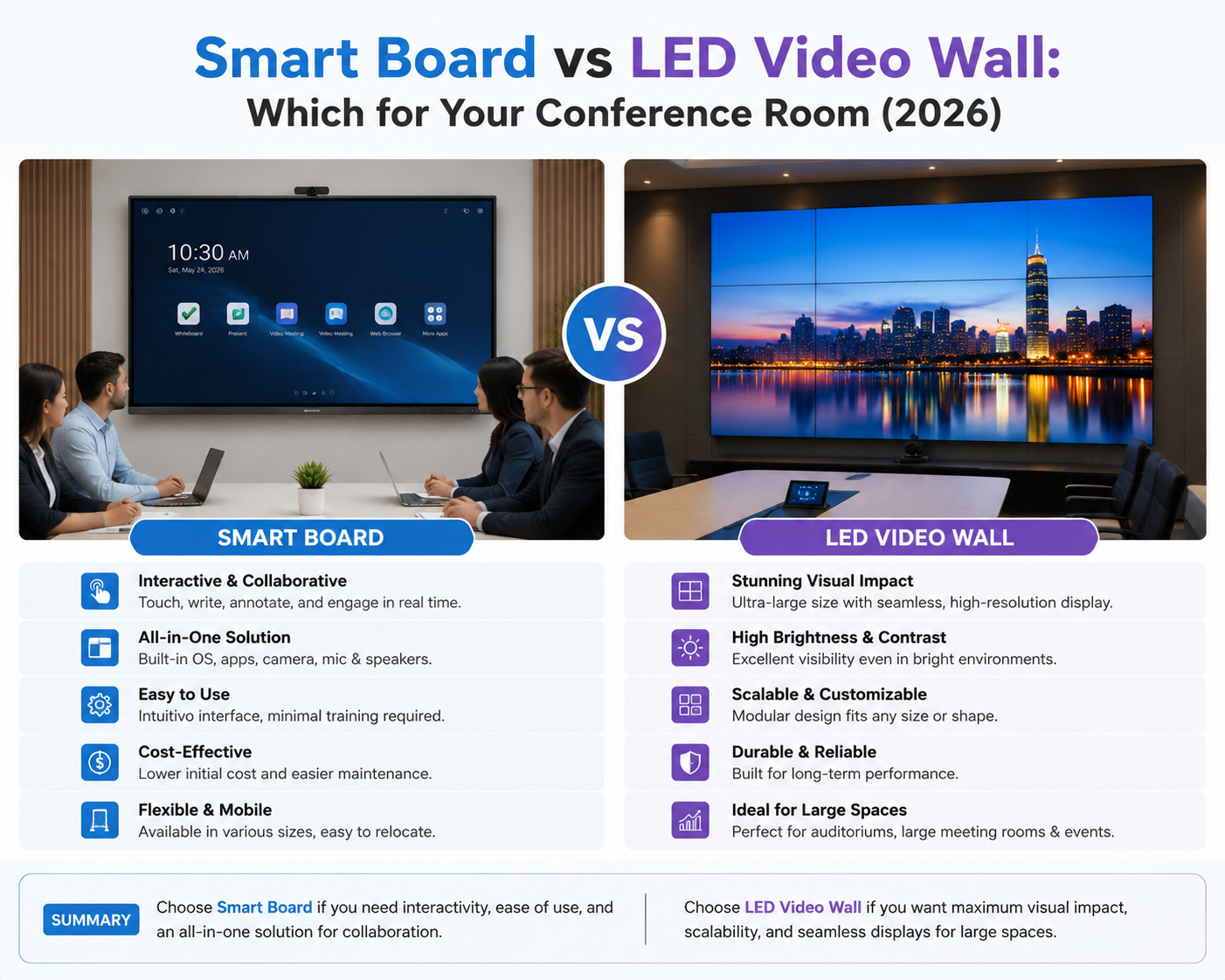
An interactive flat panel — what most people call a smart board — is a self-contained touchscreen that combines display, computing, touch interaction, and built-in speakers in one device. Sizes typically range from 55 to 98 inches, and the panel runs its own Android operating system with optional Windows via an OPS module. You write on it, you tap through presentations, you run video calls, and you annotate over shared content — all on the same surface.
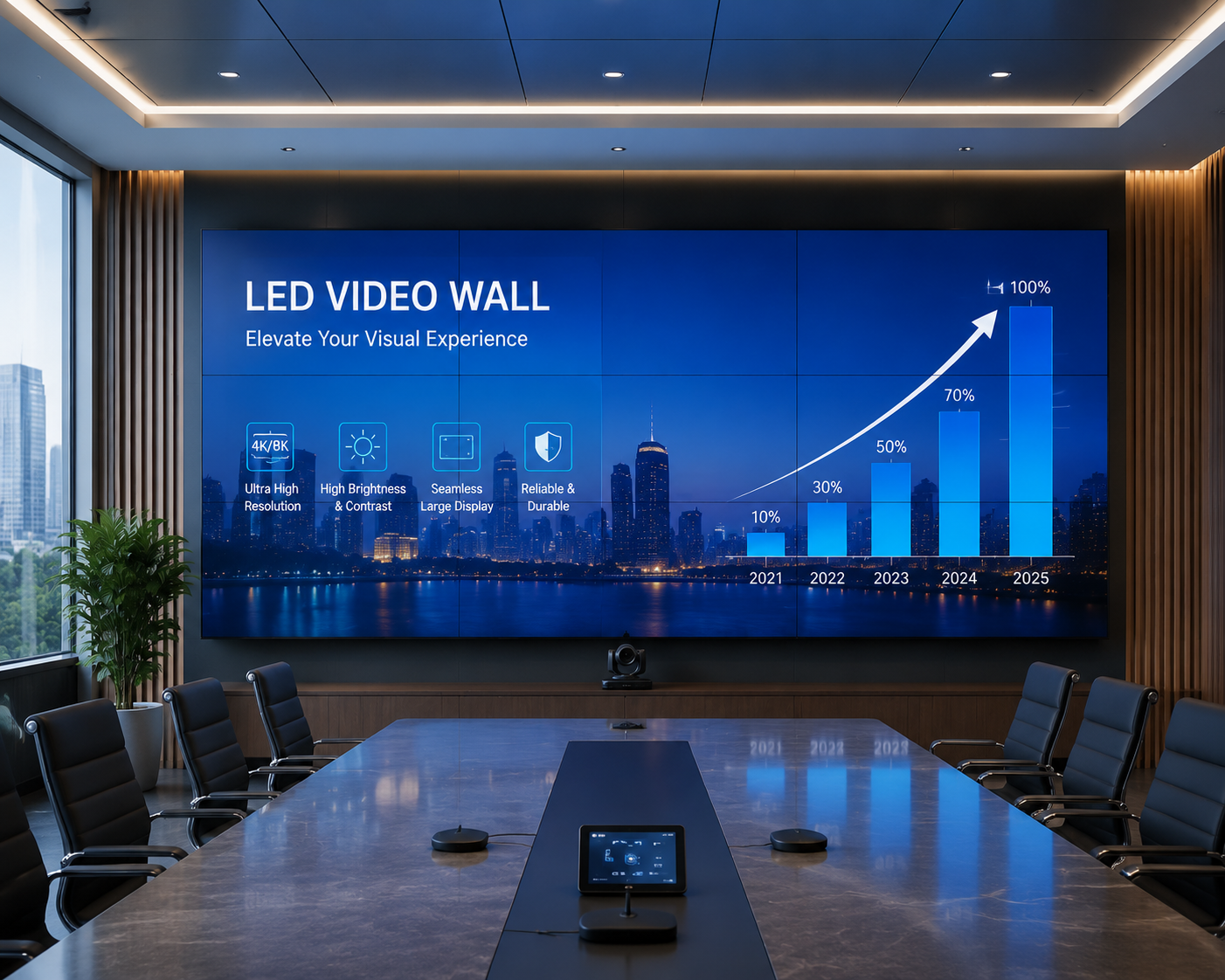
An LED video wall is a completely different animal. It is a grid of individual LED cabinets tiled together to form a seamless display, often spanning entire walls. LED walls start around 110 inches and go up from there — way up. They are direct-view LED, meaning each pixel is a tiny light-emitting diode rather than a backlit LCD layer. The result is extreme brightness, deep contrast, and zero bezels between tiles. But they lack touch capability entirely. An LED video wall is a display, not an interactive surface.
The Use Case Split
If the primary activity in the room is collaboration — whiteboarding, annotating documents, running interactive training — the smart board vs LED video wall debate ends quickly. Only the smart board supports touch. You cannot walk up to an LED wall and circle a contract clause. You cannot run a brainstorming session where three people mark up a diagram simultaneously. For meeting rooms where people work together on content rather than just watch it, the interactive flat panel is the tool that matches the workflow.
If the room is designed for presentations and broadcast-style communication — town halls, board meetings with 30 attendees, executive briefing centers where one person presents to a seated audience — an LED video wall makes sense. The brightness stays consistent even with room lights on, the size makes text readable from the back row, and the lack of touch interaction is not a drawback because nobody in those rooms is walking up to the screen anyway.
Cost and Installation
An interactive flat panel in the 65-to-86-inch range is a straightforward installation. Wall mount it, plug in power and maybe an Ethernet cable, and it is ready. The panel is a single unit, so setup takes an hour or two. Cost depends on size and configuration — a 65-inch panel runs lower, an 86-inch higher — but the total includes display, touch, computing, and audio in one purchase.
An LED video wall is a construction project. Each cabinet needs to be mounted precisely, aligned, and calibrated so the seams are invisible and color uniformity holds across the entire wall. The installation requires structural assessment of the wall, professional AV integration, and often dedicated power and cooling. Even a modest 110-inch LED wall typically costs several times more than a premium 86-inch interactive flat panel, and the price climbs sharply with size and pixel pitch.
This is not to say LED video walls are overpriced — they deliver something interactive panels cannot, namely scale and brightness. But for most corporate meeting rooms, the budget difference is decisive, and the interactive capabilities of a smart board deliver more practical value per dollar.
Audio, Cameras, and the Rest of the Room
An interactive flat panel includes built-in speakers, and many models — including those from LonTon — come with an integrated camera and microphone array. The board handles video conferencing without external peripherals, which keeps the room clean and the setup simple. An LED video wall is just a display. It needs separate speakers, a separate camera, a separate microphone, and a separate control system to tie it all together. That adds cost, complexity, and points of failure.

Which One for Your Room
For small to medium meeting rooms — huddle spaces, standard conference rooms, training rooms for groups up to 15 or 20 people — a 65-to-86-inch smart board covers the use case completely. The touch screen enables the collaboration that these rooms exist for, and the built-in conferencing hardware simplifies daily operation.
For large boardrooms, auditoriums, and executive briefing centers where the audience sits more than 15 feet from the screen, an LED video wall earns its cost through sheer visibility. But even in these rooms, some organizations pair a large LED wall for display with a smaller interactive flat panel on a mobile stand for whiteboarding — getting the best of both without forcing one technology to do everything.
As a professional manufacturer, LonTon builds interactive flat panels designed for the daily reality of corporate meeting rooms. The panels include touch, computing, camera, microphone, and wireless screen sharing through EShare out of the box. If your team spends meeting time collaborating rather than just watching presentations, an interactive flat panel is the tool that matches how you work — and the smart board vs LED video wall comparison stops being a debate and starts being a practical room-planning question.