
 English
Smart Board Manufacturer China: How to Source Interactive Flat Panels from Chinese Factories (2026)
If you typed "smart board manufacturer china" into Google, you are probably at the start of something. Maybe you have been selling interactive flat panels through a local distributor and the margins are getting squeezed. Maybe you are launching a brand and you want to go straight to the source. Either way, you have figured out what most of the industry already knows: roughly 80 percent of the world's interactive smart boards are produced in China. The question is not whether to source from China. The question is how to find the right factory and not get burned.
A smart board manufacturer china search returns pages of results — Alibaba listings, trade platform profiles, factory websites that all say the same thing. Finding a name is easy. Finding a partner who will still answer your emails long after the first shipment lands is the real challenge.

Why the Supply Chain Lives in Guangdong
Most of China's interactive flat panel production clusters in one region: the Pearl River Delta in Guangdong province. Shenzhen, Dongguan, Guangzhou, Huizhou — within a few hours' drive, you can find the LCD panel suppliers, the touch sensor manufacturers, the chipset vendors, the glass processors, and the assembly lines that turn those components into finished smart boards.
This matters for two reasons. First, a factory that sits inside this cluster has shorter lead times and more supply chain flexibility than one outside it. Second, the cluster attracts talent — the engineers who design touch systems and the production managers who run high-volume assembly lines are concentrated here.
When you are evaluating a factory, ask whether they are in Guangdong. If they are not, ask why. Some legitimate manufacturers operate elsewhere — Hisense in Qingdao, for example — but most of the specialized IFP production happens in the south.
How to Tell a Real Factory from a Trading Company
Walk into a trade show or scroll through Alibaba and you will meet two kinds of operations. One owns a production floor. The other owns a website and a WeChat account and sources from whichever factory gives them the best price that month.
A trading company is not automatically bad — some do quality control and consolidate orders well. But if you are trying to build a long-term brand, you need a manufacturer. A few simple checks will tell you which one you are dealing with before you book a flight.
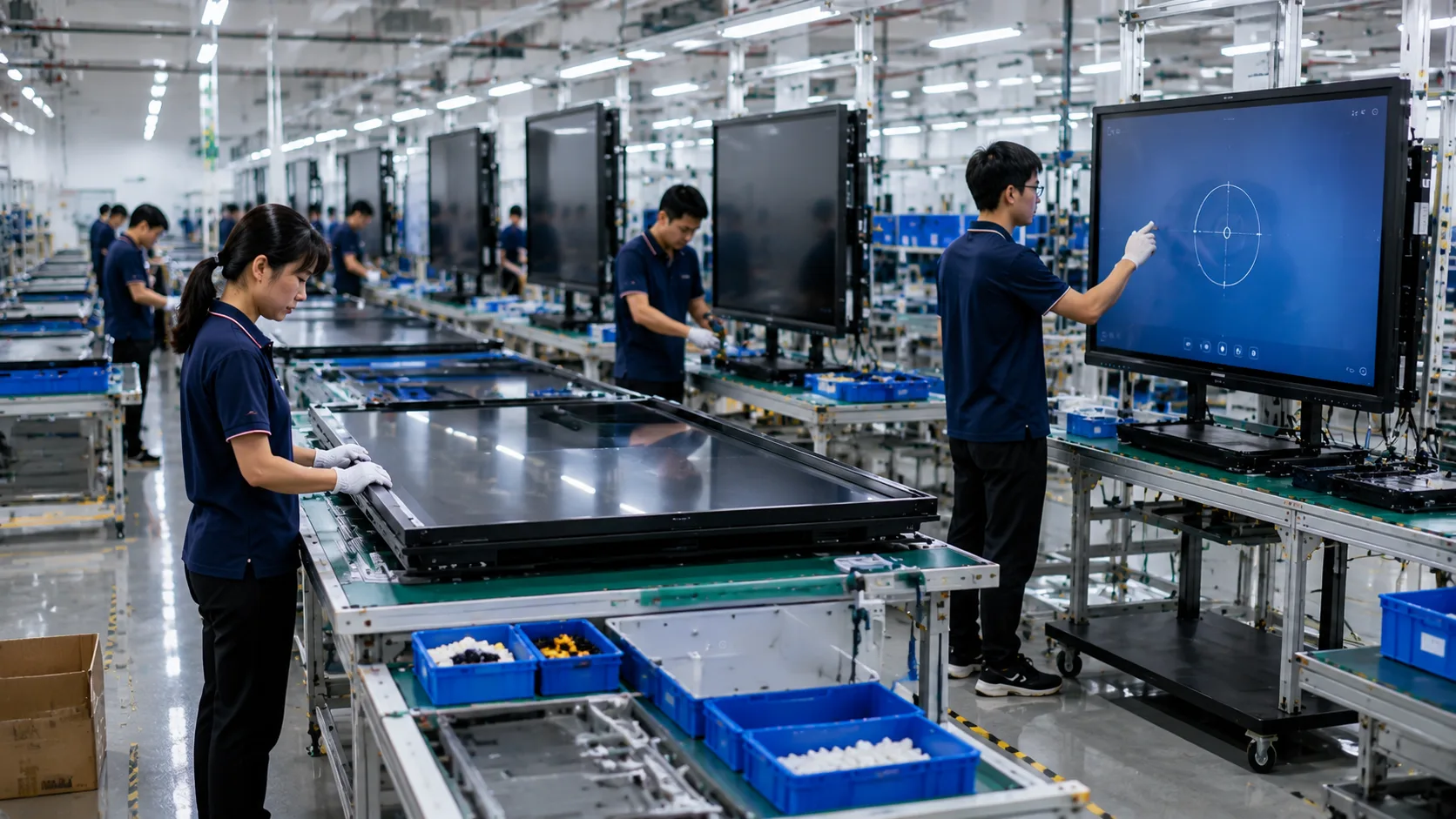
Ask for the factory address and look it up on a satellite map. Is there a production building or an office park? Ask for photos of the production line — not the showroom, the actual assembly floor. Ask how many production workers they have, not total employees. A factory with 100 production workers is a different operation from a trading office with five salespeople.
As a smart board manufacturer china ourselves, LonTon operates its own production facility in Guangdong. When a buyer asks to see the factory floor, we send them real photos — not stock images — or arrange a video walkthrough. If the factory you are talking to hesitates on this question, you are probably not talking to a factory.
Ask about certifications. CE, FCC, RoHS are the minimum for exporting to Europe and North America. If the factory cannot produce these certificates, your shipment may get stuck at customs and there is nothing you can do about it.
Ask about their export track record. Which countries have they shipped to? What were the volumes? Can they provide a reference — a client you can talk to? A manufacturer with real export experience has handled logistics, customs documentation, and after-sales support across borders. A factory doing this for the first time will learn on your order.
What Pricing Actually Looks Like
You will see prices online that range from a few hundred to several thousand dollars per unit. Both numbers can be real — they just describe different products at different volumes.
At the entry level, a basic 55-inch interactive flat panel starts around $500 from a Chinese factory — but that is a stripped-down configuration. A 65-inch panel costs more. A 75-inch panel costs more than that. Infrared touch costs less than capacitive touch across every size. Built-in computing, camera modules, mobile stands, packaging with your brand — every addition moves the price.
Volume matters enormously. The per-unit price on an order of five panels is not the same as the per-unit price on an order of fifty. A factory running a production line at full capacity can spread the setup cost across more units. Most manufacturers will give you a tiered quote — ask for it. And ask whether the quote is FOB (the factory loads the goods onto the ship, you handle everything after) or includes more.
MOQ, Lead Times, and the Calendar
The minimum order quantity for customized interactive flat panels varies by factory and by project. A factory will set its MOQ based on the complexity of your customization, your long-term volume projections, and how busy their production schedule is at the moment. Ask for it upfront — not the number on a platform listing, but the real MOQ for your specific configuration with your branding and packaging. A good manufacturer gives you a straight answer and lets you decide whether the timing works.
Which brings up the calendar. Smart board manufacturing has a busy season. Education buyers place orders in spring and summer for installation before the school year starts. Corporate buyers cluster around budget cycles. By September, many factories are running at or near capacity. If you are planning a launch, get your order locked in before the peak. Lead times stretch during these months, and the factory that promised you four weeks in March may need eight weeks in October.
Sourcing Starts with a Conversation
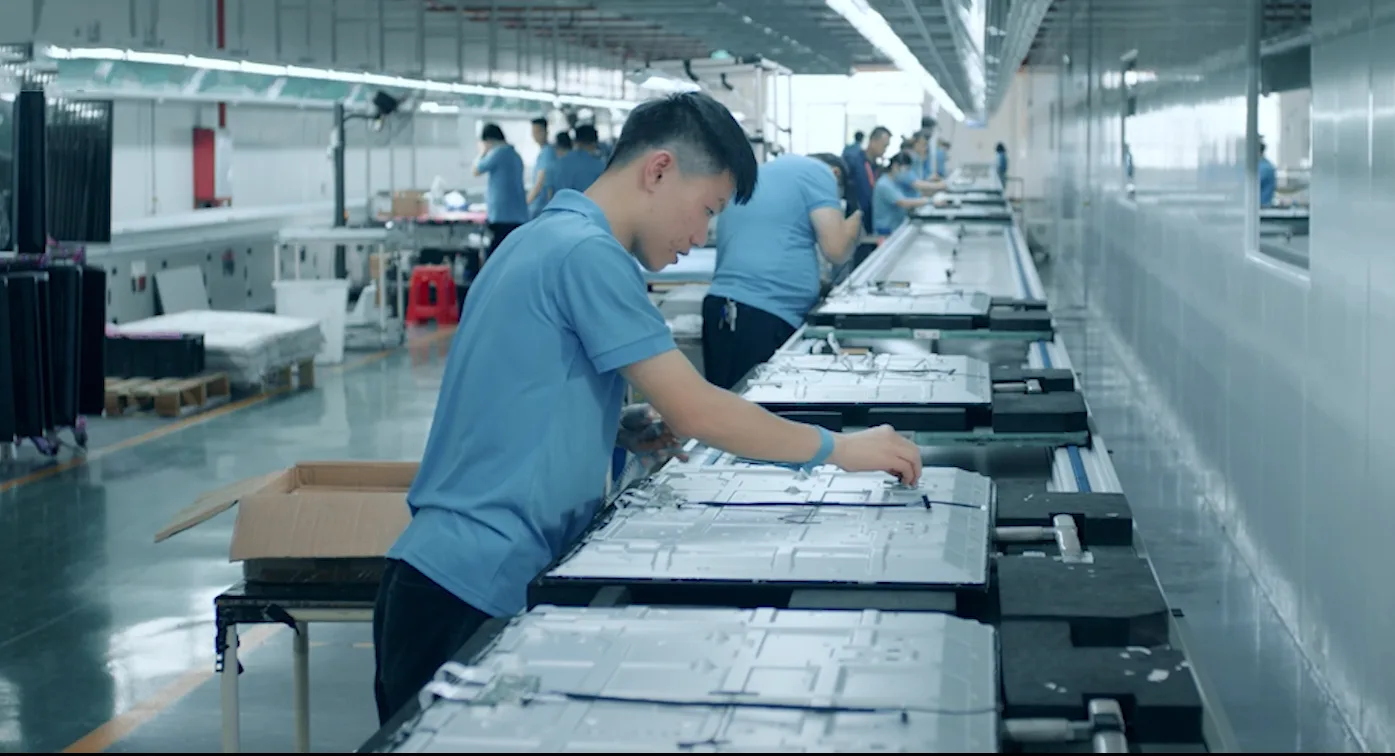
A Google search for a smart board manufacturer china gives you a list. A conversation gives you a partner. The factories worth working with answer questions directly. They send real photos. They give you a founding year without hesitating. They tell you which countries they have shipped to and what volumes. They put warranty terms in the contract, not in a chat message.
If you are sourcing interactive flat panels from China, LonTon can help. Tell us your target market, your volume expectations, and what you need customized — panel size, touch technology, branding, packaging. We will give you a configuration and a quote that reflects your project, not a catalog page. Click the inquiry button below and let us talk through what you are building. We are happy to help.