
 English
Interactive Displays for Car Dealerships: Showroom & Sales Floor (2026)
A sales manager at a dealership told me the moment he knew the old setup was costing them deals. A customer was deciding between two trims, and the salesperson pulled out a printed brochure to explain the difference. The customer flipped through it for thirty seconds, handed it back, and said, "Can you just show me?" The nearest screen was the waiting-area TV looping the same brand video for the tenth time that day. The customer walked out "to think about it" and never came back.
Car buying has moved online, but the showroom still closes the sale — and the showroom is where the screens usually stop being useful. Here's what a dealership should put in front of a customer, and where.
The showroom has three jobs, not one
Most dealerships treat a display as one thing: something to play a brand reel on. But the showroom actually asks a screen to do three separate jobs, and a single loop of marketing video only does one of them badly.
The first job is to show a specific car. When a customer is standing next to a model, they want to see that model — its trims, its colours, its option packages — not a generic montage. The second job is to compare. "What's the difference between the SE and the SEL?" is the question that decides whether a customer upgrades or stalls, and a side-by-side spec comparison on a big screen answers it in seconds instead of a ten-minute brochure hunt. The third job is to hold attention in the waiting area, where a customer sits for twenty minutes while their car is being serviced and where a stale loop quietly bores them out the door.
Where each screen earns its keep
- Next to the car. A touch panel beside the floor model lets the customer spin through colours, trims and packages themselves. It turns a static car into something they configure, and people who configure a car are halfway to buying it.
- The negotiation desk. This is the highest-leverage screen in the building. Side-by-side trim comparison, financing numbers, trade-in value — put it on a panel both the customer and the salesperson can see and touch, and the conversation stops being a lecture and becomes a shared decision.
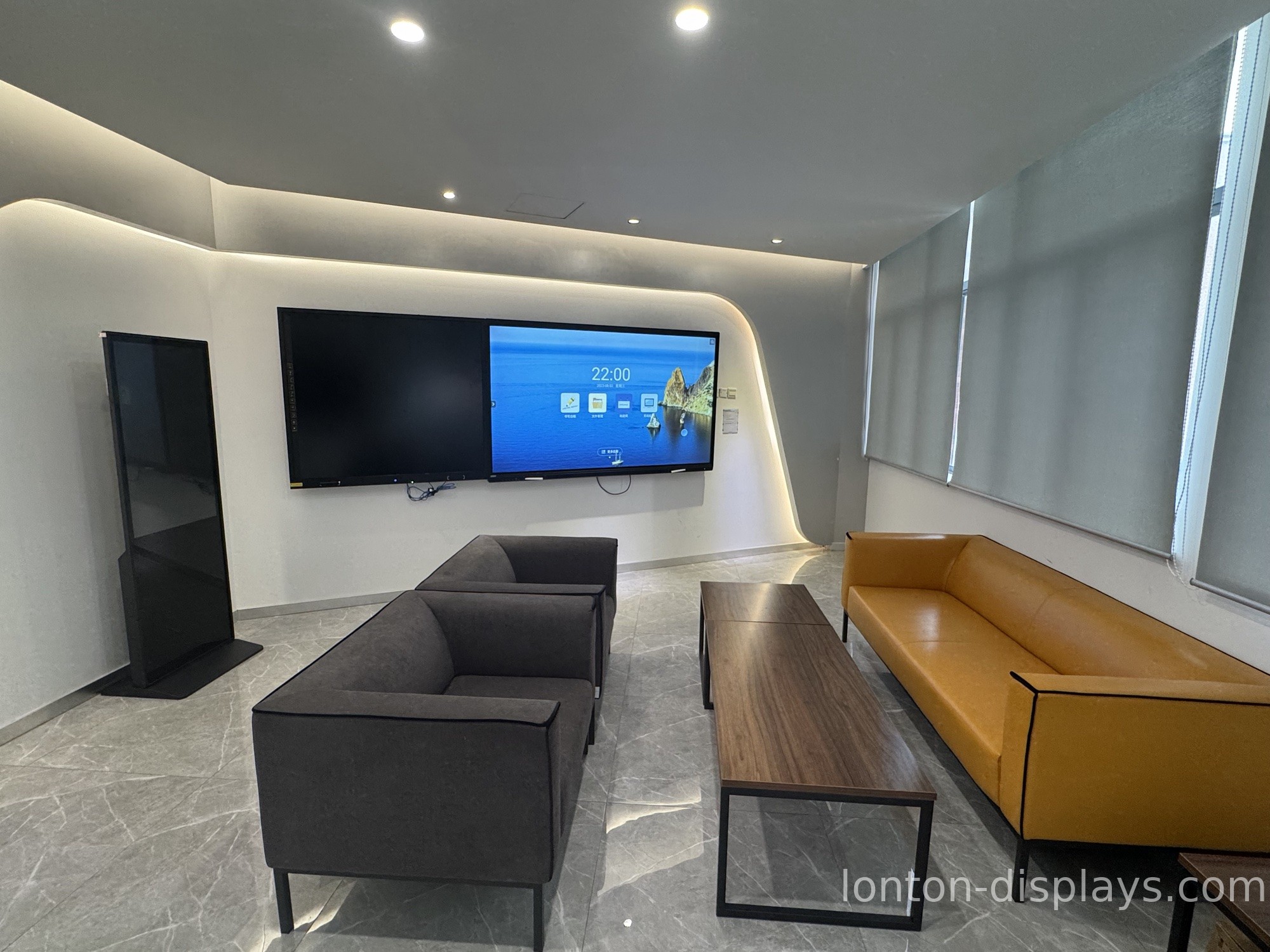
- The service waiting area. While the car is in the bay, the customer is a captive audience. A screen that shows their service progress, or lets them browse accessories, is worth ten loops of the same ad.
What a dealership panel actually needs
Dealerships have one constraint most other businesses don't: light. A showroom is all glass and high-ceiling lighting, so a screen that looks fine in a dim office turns into a mirror the moment the sun comes through the front window. Anti-glare glass isn't optional in a showroom — it's the difference between a customer seeing the car's interior colour and seeing their own reflection.
The second thing is touch that responds to a customer, not just a stylus. A customer standing in a showroom wants to poke a colour swatch and see the car change, and if the screen lags or misses, the magic evaporates. Fast, accurate multi-touch keeps the demo alive.
And the third thing is durability for the service bay. That waiting-area screen runs ten hours a day, seven days a week. It needs to be built for continuous operation, not consumer electronics that overheat by month six.
How Lonton fits a dealership
We build interactive flat panels for exactly this kind of high-traffic, high-light, all-day environment. The glass is anti-glare so a sunlit showroom doesn't turn the screen into a mirror, and the 40-point infrared touch is fast enough that a customer tapping a trim option sees the change instantly. The panels are built for continuous commercial use, not for a living room — which is what a service-bay screen running all day actually needs.
Because we're the factory, a dealership chain can outfit every location on one platform, with OEM/ODM branding — your logo on boot, your configurator loaded in, your colours locked to the brand — and a factory-direct price that doesn't carry AV-integrator markup. 100,000+ square metres, 15 production lines, every panel inspected before it ships.
Put the screen where the decision happens
A dealership doesn't need more screens; it needs the screens it has in the right places — next to the car, at the negotiation desk, and in the service waiting area. Those are the three spots where a customer is actually deciding. Tell us how many locations and what you want on the panels, and we'll spec the fleet and send a factory-direct quote, usually within 24 hours.
FAQ
Why does a dealership need anti-glare glass?
Showrooms are full of glass and overhead light. Anti-glare keeps the screen readable instead of turning it into a mirror.
Can customers configure a car on the panel?
Yes. Touch lets customers spin through colours, trims and packages themselves, right beside the floor model.
Can we use it for trim comparisons at the desk?
Yes. A big touch panel makes side-by-side trim and financing comparisons a shared, touchable decision.
Will it run all day in the service area?
Yes. Lonton panels are built for continuous commercial use, not consumer electronics.
Can Lonton brand the panels for our dealership group?
Yes. OEM/ODM covers boot screens, configurators and brand-locked colours.
Can we outfit multiple locations on one platform?
Yes. Factory-direct volume pricing and one platform make a multi-location rollout simple.