
 English
How OEM Interactive Flat Panel Manufacturing Works (2026)
You have landed on an OEM agreement with a factory. You have signed off on the product specification. The deposit is transferred. Now what actually happens between that moment and the day a container full of panels with your brand on them arrives at your port?
If you have never been through OEM interactive flat panel manufacturing before, the timeline between design sign-off and shipment can feel like a black box. You know the factory is working, but you are not sure what they are doing — or what you should be doing on your side during that window.
Let us walk through the stages. Not from the factory's internal perspective — engineering teams can fill a manual with that. From your perspective as the buyer: what is happening, when you should ask questions, and what you should be preparing while the factory builds.

Design Lock and BOM Finalization
The first stage of OEM manufacturing begins with paperwork, not hardware — and it matters more than most first-time buyers realize.
After the quotation is accepted, the factory and the buyer lock the Bill of Materials. Every component gets specified: the LCD panel grade, the touch technology — infrared or capacitive — the glass finish, the Android board configuration, the camera module if included, the OPS slot if specified, the bezel design, the logo placement, the boot animation, the packaging artwork, the user manual language. Every one of these choices becomes a line item and every line item has a cost and a lead time attached.
This is also the window where changes are cheap. Moving the logo three millimeters or swapping to a matte glass finish during the design-lock phase is an email. After the first production run starts, the same change costs time and materials. The buyer's job during this stage is review — read the BOM line by line, confirm every choice, and do not sign off until you are certain.
LonTon buyers typically spend this phase working through a detailed specification checklist with the engineering team, confirming every component before production tooling begins.
Prototype and Pre-Production Sample
Once the BOM is locked, the factory builds a small number of pre-production units — usually one to five panels. These are not off-the-shelf products with your logo added. They are the first physical realization of your specification.
This is the most important stage for the buyer. You are not just checking that the panel turns on. You are checking that the bezel looks the way you pictured it, that the touch response feels right, that the boot animation reads clearly, that the software loads in the language your customers speak, that the packaging protects the panel the way it needs to for the shipping distance to your country.
If something is wrong, this is when you catch it. After the prototype is approved, the factory commits to full production. Changes after this point are expensive and slow. Some buyers fly to the factory for this stage. Others receive video walkthroughs and shipped samples. Either way, do not rush the approval. A mistake caught in the prototype stage costs hours. The same mistake caught in the shipping container costs a quarter of your revenue.
Full Production and Inline Testing
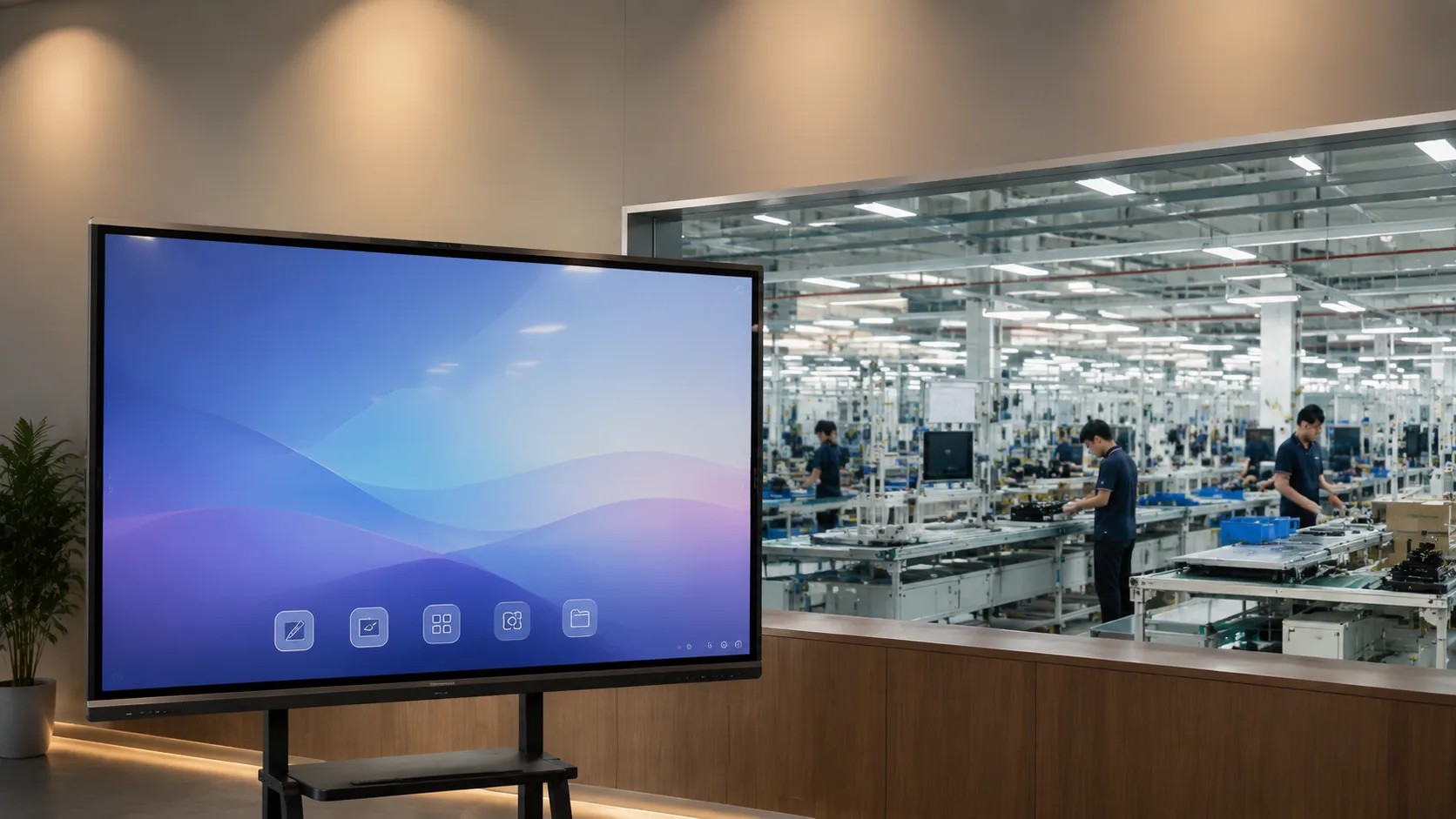
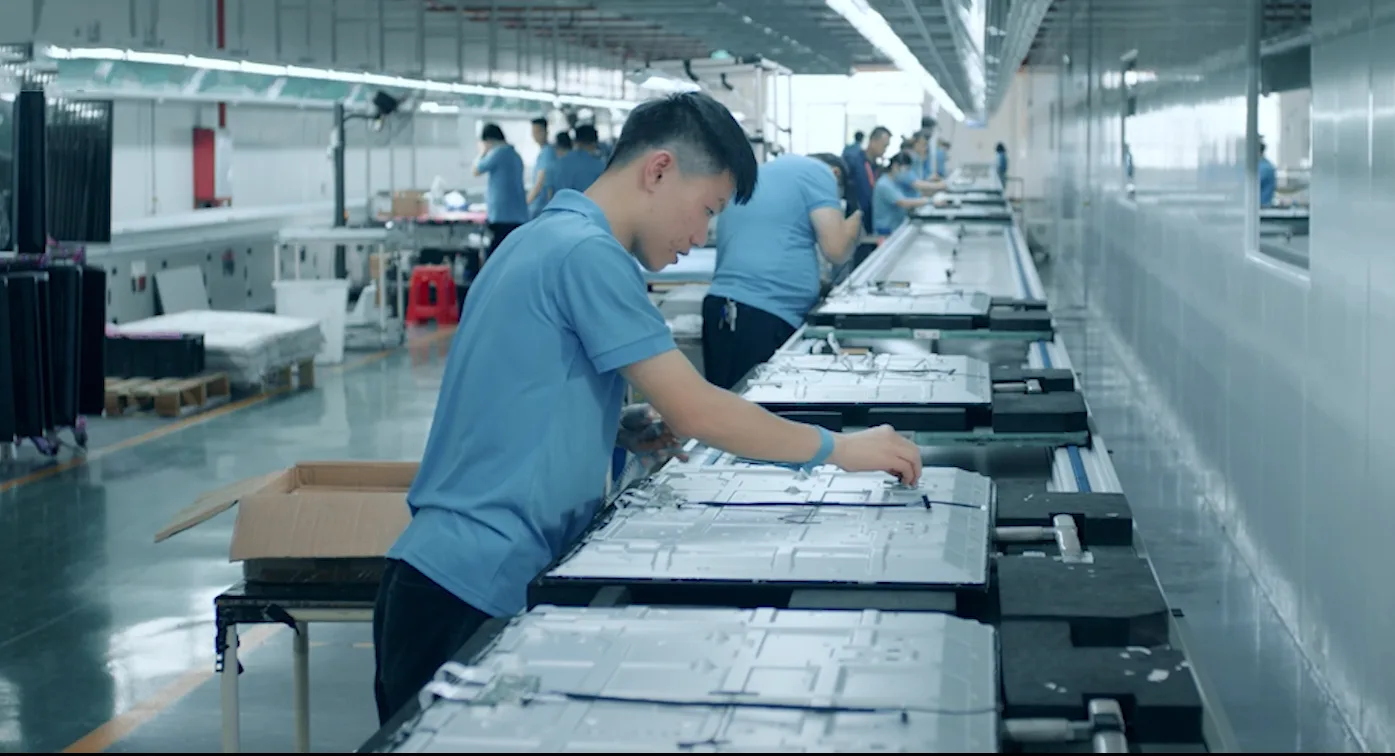
With prototype approval in hand, the factory moves to full production. This is the phase where OEM interactive flat panel manufacturing looks most like what you would picture: assembly lines, workers at stations, panels moving through build stages.
For the buyer, this is not a hands-off phase. Ask the factory for production-line photos or short video clips at agreed milestones — when the first batch completes assembly, when testing begins, when the aging process starts. You are not micromanaging. You are documenting what happened so that if something goes wrong later, you have a timeline.
Ask about inline testing. Most factories run each panel through a series of checks — touch calibration, display uniformity, software function, connectivity, burn-in aging. Ask what that checklist looks like for your order. A factory that is transparent about its testing process is giving you confidence. One that answers vaguely about testing is giving you something else.
Packaging, Palletizing, and Container Loading
The panels are built and tested. Now they need to survive a journey that might involve a truck, a port, an ocean crossing, another port, customs clearance, and a final delivery truck — sometimes across multiple climate zones.
Packaging is not just about putting a box around the product. For interactive flat panels — large, heavy, glass-faced displays — packaging design is about shock absorption, humidity protection, and stackability. The wrong packaging decision saves a few dollars per unit at the factory and costs ten times that in damaged panels at the destination.
Ask the factory what kind of packaging they use for international OEM shipments — foam density, corner protection, pallet configuration — and whether they offer reinforced packaging for longer routes. If your shipping lane involves tropical humidity or winter salt spray, ask about moisture protection. These questions tell you whether the factory ships locally or internationally. A factory that ships globally has packaging designed for the worst-case route, not the easiest one.
LonTon configures packaging per shipment destination, adjusting for route distance, climate, and handling conditions at the receiving port. A panel headed for a dry inland warehouse gets different packaging than one crossing the equator on an ocean freighter.
What Happens While You Wait
Between prototype approval and container arrival, the buyer has a window — sometimes six to ten weeks. Here is what you should be doing during that window, because the buyers who wait until the panels land to start preparing are the ones who lose weeks on the back end.
Prepare your local deployment materials: user manuals in the local language, installation guides, training videos, marketing assets with the final product photos. Set up your after-sales process: who handles customer calls, where spare parts live, how you handle warranty claims in your market. Train your installation team on the panel configuration before the shipment arrives so day one after delivery is deployment, not learning.
The factory builds the product. The buyer builds the business around it. The timeline works best when both happen in parallel.
The Right Factory Makes the Process Transparent
OEM interactive flat panel manufacturing is not supposed to be mysterious. A good factory partnership means you know what is happening at each stage — not because you are hovering over the production line, but because the factory communicates proactively.
This is one of the things that separates an experienced OEM factory from one that built its first custom order last year. Communication cadence, milestone documentation, testing transparency — these are as much part of the manufacturing process as the assembly line itself.
As a professional manufacturer, LonTon has been producing interactive flat panels since 2005. That tenure does not guarantee your order will be perfect — no factory can promise that — but it does mean the process is established, the communication routines are built in, and the surprises that trip up a younger factory are problems our engineering team has already solved.
If you are researching OEM manufacturing for interactive flat panels and want to understand what the process looks like for your project — timelines, milestones, what to expect at each stage — reach out to LonTon. Tell us about your product requirements and target market. We will walk you through the manufacturing stages as they would apply to your order, with real timelines and real checkpoints, not a generic flowchart. Click the button at the bottom right of this page and tell us about your project.