 English
Infrared touch technology is the workhorse behind most interactive flat panels on the market today. It is not the newest technology, and it is not the flashiest. But it is the one that handles eight hours of daily use in a classroom without complaining, and that is why it has become the standard.
The way it works is simpler than most people expect. Around the inside edge of the display bezel sits a frame lined with tiny infrared LED emitters on two adjacent sides and matching photodetectors on the opposite sides. The emitters fire invisible beams of infrared light across the screen surface, creating a dense grid. When nothing is touching the screen, every beam reaches its detector uninterrupted. When you press your finger against the glass, you break a few of those beams. The board's processor reads which beams got interrupted, does a quick triangulation, and registers a touch at that exact coordinate.
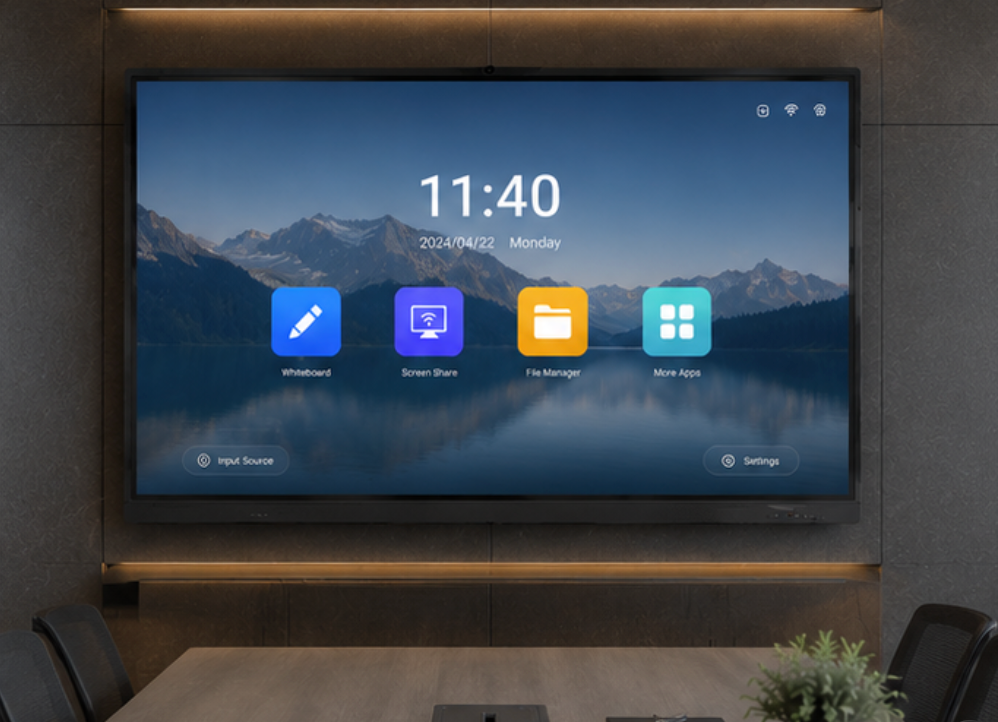
This all happens fast enough that you never notice it. The scan rate on a modern IR touch frame is typically 6 to 8 milliseconds, which means the board can track your finger moving across the screen in real time without lag. Multiple touch points — up to 40 on current boards — work the same way. Each interruption in the grid is tracked independently, so the board can tell the difference between your finger and your colleague's finger even when you are both writing at the same time.
One underappreciated advantage of infrared touch technology is that it does not care what touches the screen. A bare finger works. A plastic stylus works. A capped whiteboard marker works. A gloved hand in a hospital training room works. The board is not sensing the object itself — it is only sensing the interruption in the light grid. This is a big deal in classrooms, where kids grab whatever is nearby, and in industrial training environments where people wear gloves or use tools as pointers.
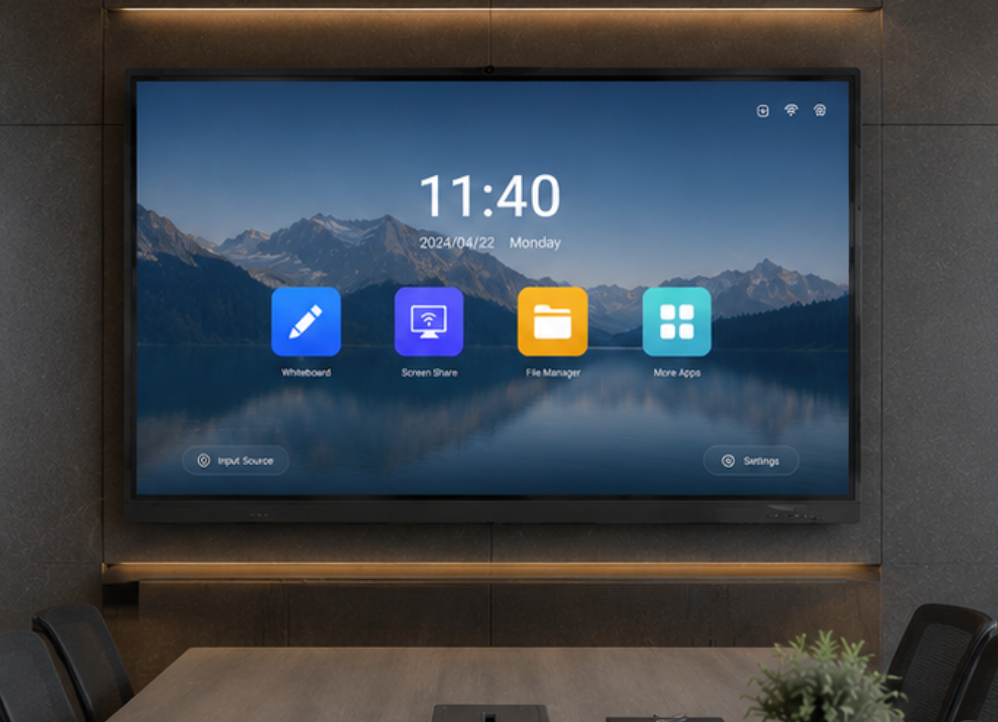
Compare this to capacitive touch, which requires a conductive object — essentially a bare finger or a special stylus. Capacitive feels more like a smartphone, but it refuses to work with gloves, plastic pens, or anything non-conductive. For a board that gets used by dozens of different people every day, infrared is simply more practical.
Another reason infrared has become the standard is durability. The LED emitters and photodetectors are solid-state components with no moving parts. They do not wear out from use. There is no calibration drift — the grid is either working or it is not, and when it is working, it is perfectly accurate every time. If something does go wrong with the touch frame, replacing it is straightforward because the IR frame is a separate component from the display panel. On a capacitive board, the touch layer is bonded to the glass, which makes repairs more involved and more expensive.

The one real limitation of infrared touch technology is that the bezel needs a small gap — typically a few millimeters — between the glass and the frame to allow the light grid to function. This means the surface is not completely flush from edge to edge the way a capacitive screen is. For most meeting rooms and classrooms, this is an invisible detail. For an executive boardroom where aesthetics matter more than practicality, it might be worth considering capacitive instead.
As a professional manufacturer, LonTon offers both infrared and capacitive touch across its interactive flat panel line — the choice depends on the room and how it gets used. For a classroom that needs to survive dozens of users who will never read a manual, infrared is the pick. Up to 40 touch points, zero-maintenance, and compatible with any object you put to the screen. It is not the fanciest technology on the spec sheet, but it is the one that still works perfectly three years later when nobody remembers where the manual went.