
 English
Why a Cleanroom Matters for Interactive Flat Panel Quality
An interactive flat panel can look flawless on the day it's unboxed and still develop problems six months later. Dead pixels, faint bright spots, uneven backlight — none of these show up during the demo. They come from the way the panel was built. That's why the factory's cleanroom matters far more than most buyers realize.
What actually kills an interactive flat panel
Most buyers assume a panel fails because it's been used hard every day. In our experience, that's rarely the real cause. What shortens the life of a panel's electronics is usually the environment it was assembled in, not the one it's used in.
Three things do the real damage:
- Dust. One particle trapped under the glass or on a circuit board can become a dead pixel or a short over time.
- Moisture. Humidity creeps into connectors and boards and corrodes contacts long after the panel leaves the factory.
- Temperature swings. Components expand and contract. Solder joints crack. Connections loosen.
None of these are visible when you unbox the panel. They're slow failures that surface weeks or months after installation — usually after the panel is already mounted on a customer's wall.
What a Class 10,000 cleanroom actually does
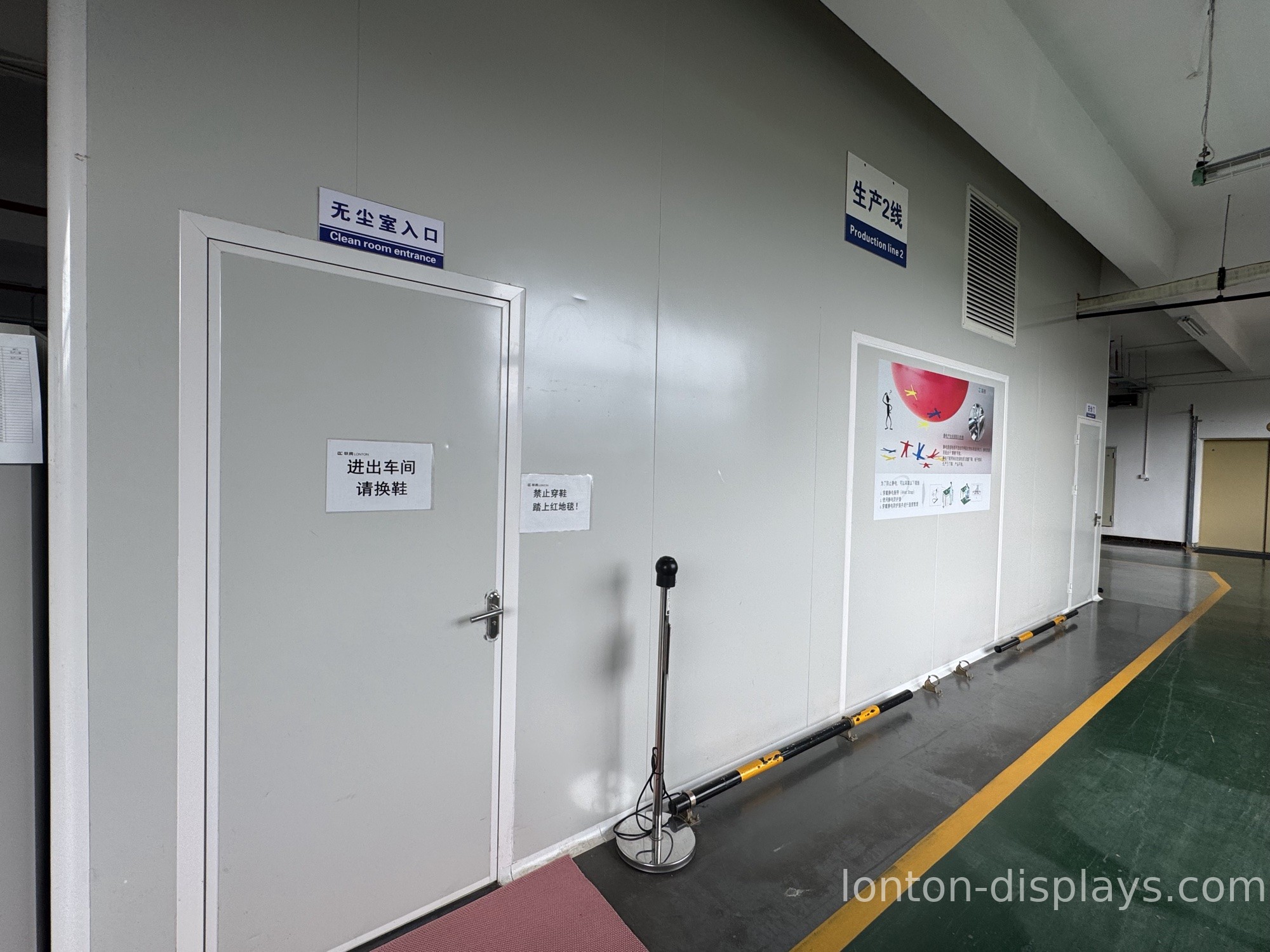
A Class 10,000 cleanroom (ISO 7) keeps the air clean enough for display assembly, where a single speck of dust can ruin a pixel. Air is filtered continuously, and people enter through air showers so outside contamination stays out.
But the cleanroom is only half the story. The part buyers don't think about is what it controls besides dust: temperature and humidity.
In our cleanroom, a central air-conditioning system with dedicated intake and outlet vents handles the airflow and temperature, while standalone humidifiers hold the moisture level steady. Together they keep the whole room at a constant temperature and humidity, all year round. That stability matters more than people think — because it's not the dust you can see that ruins panels, it's the dust and moisture you can't.
The hidden problem: dust you can't see yet
Dust-related defects have a lag. A panel assembled in a dusty workshop can pass a visual check, pass a 24-hour test, and still develop bright or dark spots a few months after installation. By the time the end user notices, the panels have already been sold and shipped. The return freight alone can wipe out the margin on the whole order.
This is one of the quiet reasons cheap panels stay cheap. A manufacturer that skips the cleanroom isn't saving you money — they're betting that the defect won't show up until after the goods have left their hands.
Why humidity control matters as much as dust
Most people think of a cleanroom as a dust-free room, but humidity is just as destructive. Too much moisture corrodes contacts and shortens component life. Too little builds static, which attracts dust and can damage circuits during assembly. Keeping humidity in a steady range is part of what separates a real cleanroom from a room that's just swept and wiped down.
That's why we run standalone humidifiers alongside the central air system. It isn't one machine trying to do everything — it's separate systems each doing one job properly.
How we build panels: a 23,000 m² Class 10,000 cleanroom
Why can we guarantee our panels will keep running for years, not break down? Because we start protecting them from the moment they're assembled.
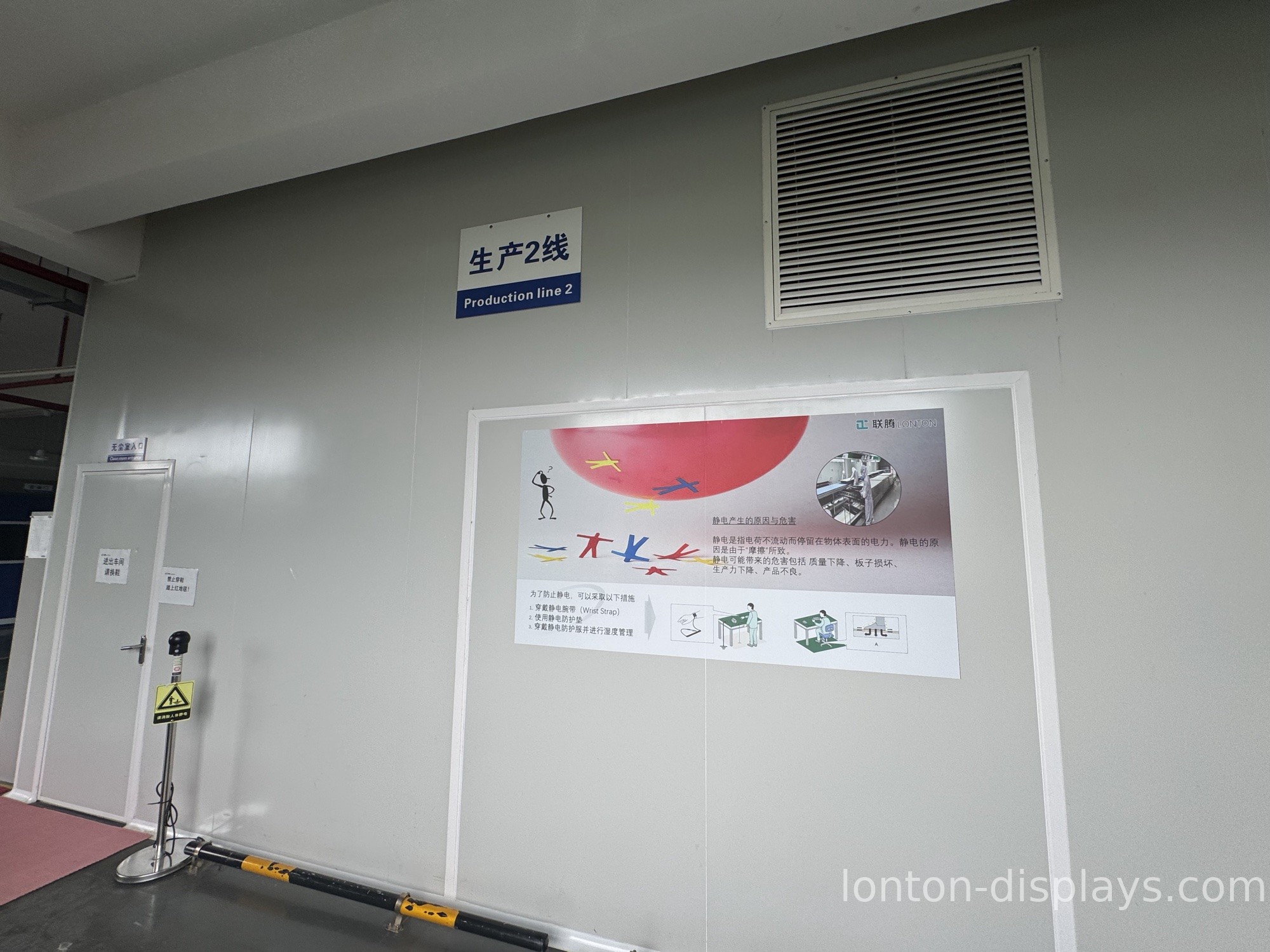
Every panel is built in our Class 10,000 cleanroom, where central air conditioning and standalone humidifiers hold the temperature and humidity steady all year round. Dust, moisture, and temperature swings are what quietly kill a panel's electronics — so we keep all three out, starting from step one.
The failures you'd see later almost never come from years of use. They come from the way the panel was built. Protect it before it's even assembled, and the one on your wall is built to last for years — not built to break.
That cleanroom is part of a larger operation: a 100,000+ m² manufacturing facility with 15 production lines and a 12,000+ m² warehouse. Panels use BOE and CSOT LCD screens. Our first-pass yield is 98%, our quality pass rate is 99.95%, and we've held ISO 9001, ISO 14001, and ISO 45001 certification since we started in 2005.
What to ask any manufacturer about their cleanroom
If you're vetting factories, the cleanroom is one of the fastest ways to tell a real manufacturer from a trading company. Ask for specifics, not adjectives:
- What class is the cleanroom, and how big is it?
- Is temperature and humidity actively controlled, or just air-conditioned?
- Can I visit and walk the line myself?
A factory with a real cleanroom will give you numbers and invite you to see it. One that doesn't will talk around the question. For a full checklist, see our guide on how to vet an interactive flat panel factory.
Get a factory-direct quote
If you're sourcing interactive flat panels — for education, corporate, or your own brand — the cleanroom is worth asking about before you commit to a supplier. Tell us the sizes and quantities you're looking at, and we'll send a factory-direct quote. You're also welcome to visit the factory and walk the cleanroom line yourself.
Contact us or browse our interactive flat panels.
FAQ
What is a Class 10,000 cleanroom?
A Class 10,000 cleanroom (ISO 7) is a controlled environment where the air is continuously filtered to keep particle counts low enough for electronics assembly. It's the standard environment for assembling LCD displays, where a single dust particle can create a dead pixel.
How does humidity affect an interactive flat panel?
High humidity corrodes connectors and shortens component life. Low humidity builds static electricity, which attracts dust and can damage circuits. A cleanroom that controls humidity protects the panel during assembly — which is when most long-term defects are created.
Why do some cheap panels develop dead pixels months after purchase?
Dust trapped during assembly often doesn't show up immediately. A particle under the glass or on a board can stay invisible for weeks or months, then surface as a dead pixel or bright spot once the panel has been shipped and installed. This is why a cleanroom matters more than a one-time visual inspection.
Can I visit the factory to see the cleanroom?
Yes. We encourage buyers to visit our factory in China and walk the production line, including the cleanroom. A manufacturer that won't let you see the line is a red flag.